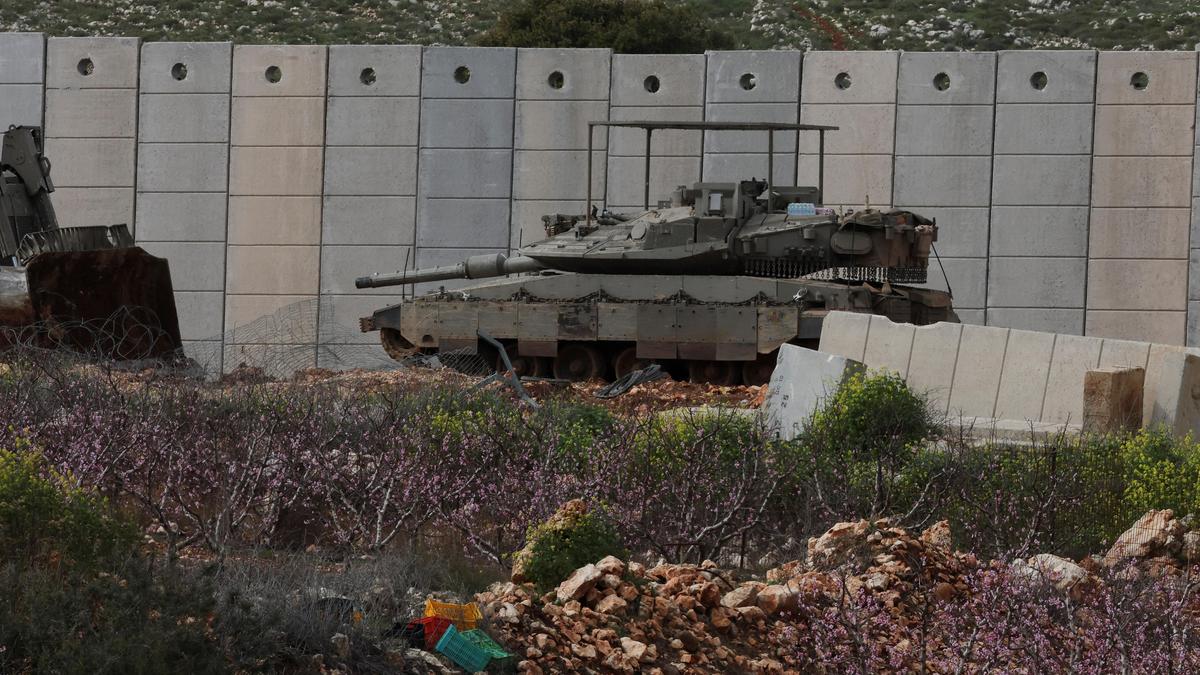
The Israeli Defense Forces (IDF) have shifted from targeted incursions to a massive, multi-divisional offensive across the Blue Line, doubling their troop presence in southern Lebanon within a matter of days. This is no longer a search-and-destroy mission for localized tunnel shafts. It is a full-scale attempt to redraw the security map of the Levant by force. By pouring tens of thousands of soldiers into the rugged terrain of the Galilee panhandle and beyond, Israel is betting that sheer mass can solve the problem of Hezbollah’s short-range rocket fire where precision strikes failed.
The objective is clear on paper. The IDF wants to clear a buffer zone roughly five to ten kilometers deep, ensuring that Hezbollah’s elite Radwan Force cannot launch a cross-border raid similar to the events of October 7. But the ground reality is a meat grinder. Hezbollah has spent nearly two decades preparing for this exact moment. They have turned the limestone hills and civilian basements of southern Lebanon into a subterranean fortress.
The Strategy of Saturation
Doubling the troop count is a move born of necessity rather than preference. In the initial weeks of the ground operation, the IDF relied on smaller, agile units to map out the outskirts of border villages. They found that Hezbollah’s defense is not a traditional frontline but a porous, lethal web. To dismantle this, Israel had to transition to a saturation strategy.
You cannot secure a village like Maroun al-Ras or Aita al-Shaab by driving through it. You have to occupy every house. You have to peel back the floorboards of every kitchen and probe the soil of every olive grove. This requires a staggering amount of manpower. By deploying the 91st, 36th, and 98th divisions simultaneously, the Israeli command is attempting to overwhelm Hezbollah’s ability to coordinate localized ambushes. They are trying to be everywhere at once so that the defender has nowhere to hide.
This surge comes at a high price. Logistics in southern Lebanon are a nightmare. The roads are narrow, winding, and easily targeted by Kornet anti-tank guided missiles. By doubling the number of boots on the ground, Israel has also doubled the number of targets for Hezbollah’s guerrilla-style hit-and-runs.
House to House in the Heart of the South
The search of homes in southern Lebanon is not merely a search for weapons; it is a forensic dismantling of a society that has been integrated into a military apparatus. IDF footage shows living rooms converted into munitions depots and bedrooms featuring hidden hatches leading to concrete-reinforced bunkers.
This isn't just "stashing guns." It is a sophisticated, decentralized logistical system. Hezbollah’s strategy relies on "nature reserves"—wooded areas with hidden launchers—and "civilian shields"—homes that act as nodes in a massive communication and supply network. When Israeli soldiers enter these homes, they aren't just looking for AK-47s. They are looking for the maps, the radios, and the operational orders that reveal how the local cell operates.
The grim reality of this house-to-house combat is that it renders the villages uninhabitable. Even if the structures remain standing, the discovery of a tunnel under a foundation often leads to controlled demolitions. Israel argues this is the only way to ensure the infrastructure cannot be reused. Critics and humanitarian observers see the erasure of entire border communities.
The Hezbollah Response and the Trap of Attrition
Hezbollah is not fighting like a conventional army. They are not trying to hold the border. They are trying to bleed the IDF. Their tactical manual involves letting the armored columns pass, then emerging from hidden spider holes to strike the supply lines.
The increase in Israeli troops plays into this hand in a dangerous way. More troops mean more fuel trucks, more medical evacuations, and more stationary outposts. Hezbollah’s use of FPV (First Person View) drones has evolved rapidly, mimicking tactics seen in Ukraine to bypass the active protection systems on Israeli tanks.
There is a fundamental tension in Israel's current posture. They need the troops to clear the area, but the longer those troops stay, the more they become targets in a war of attrition that Hezbollah is built to win. The goal of returning 60,000 displaced Israelis to their homes in the north remains elusive as long as Hezbollah can still fire rockets from just behind the IDF’s forward positions.
The Intelligence Gap and the Hidden Front
While the physical fighting happens in the mud and rubble, a secondary war is being fought in the electromagnetic spectrum. Israel's doubling of forces includes a massive deployment of electronic warfare units. They are attempting to jam Hezbollah’s command-and-control links, which have been severely frayed by the earlier pager and walkie-talkie attacks.
However, Hezbollah has pivoted to wired, fiber-optic communications that are immune to jamming. This forces the IDF to physically find and cut the lines. It is a slow, grueling process that belies the "lightning strike" rhetoric often heard from political leaders in Tel Aviv.
Furthermore, the deeper the IDF pushes, the more they expose their flanks to Lebanese Armed Forces (LAF) positions and UNIFIL outposts. While the LAF stays out of the direct fight, their presence complicates the battlespace. The international pressure to avoid civilian casualties and keep the Lebanese state from total collapse puts a ceiling on how much "total force" the IDF can actually apply.
The Strategic Gamble of the Buffer Zone
History is a heavy weight in this region. Israel has tried "security zones" in Lebanon before, most notably from 1985 to 2000. That effort ended in a chaotic withdrawal and the subsequent rise of Hezbollah as the dominant power in Lebanon.
The current surge suggests that the IDF believes it can achieve a different result through superior technology and a more aggressive dismantling of civilian-military infrastructure. But a buffer zone is only effective if you can hold it without losing a dozen soldiers a week to IEDs and snipers. If the IDF clears the five-kilometer mark, Hezbollah will simply move their longer-range assets to the six-kilometer mark.
The Israeli public’s patience is the ticking clock here. While there is broad support for removing the immediate threat to the north, the appetite for a prolonged occupation is non-existent. The IDF is racing against a diplomatic clock and a domestic one, trying to do enough damage to Hezbollah’s local infrastructure to buy years of quiet before the inevitable political settlement.
The Failure of Deterrence
This massive escalation is, at its core, an admission that air power has failed. For a year, Israel struck Lebanon from the sky, hoping to convince Hezbollah to decouple its fight from the war in Gaza. It didn't work. The move to double the ground force is the final card.
If this surge fails to stop the rocket fire, the IDF faces a terrifying choice. They can either push further north toward the Litani River—expanding the war significantly—or they can withdraw and admit that the threat cannot be removed by military means alone.
The soldiers currently tossing grenades into tunnels and searching through abandoned Lebanese kitchens are the vanguard of a policy that has no clear exit. They are destroying a localized threat while simultaneously fueling a regional grievance that will likely outlast the current conflict. The ground in southern Lebanon is being cleared, but the seeds of the next war are being planted in the very same soil.