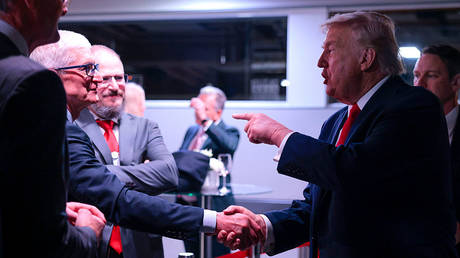
Donald Trump’s recent recollection of telling Apple CEO Tim Cook to "kiss my ass" during a high-stakes negotiation isn't just another piece of campaign trail theater. It serves as a window into a raw, transactional style of governance that fundamentally altered how Silicon Valley interacts with Washington. While the anecdote focuses on a colorful insult, the underlying mechanics reveal a calculated pressure campaign that forced the world’s most valuable company to choose between its global supply chain and its domestic political survival. This was never about a simple phone call; it was about the systematic dismantling of corporate neutrality.
The friction between the White House and Cupertino centers on a singular, recurring demand: move manufacturing from China to the United States. For decades, Apple built an empire on the back of efficient, low-cost labor in Zhengzhou and Shenzhen. When Trump entered the Oval Office, that efficiency became a political liability. By threatening massive tariffs on iPhones and MacBooks, the administration turned the tax code into a weapon, forcing Cook to become a frequent visitor to the West Wing. The "kiss my ass" remark, according to Trump’s account, was the opening salvo in a negotiation that eventually saw Apple agree to a symbolic $1 billion investment in a Texas manufacturing facility.
The Myth of the Texas Factory
To understand the power dynamic at play, one must look closely at the Mac Pro assembly line in Austin. Politicians often point to this facility as a triumph of American manufacturing. The reality is far more nuanced. The Austin plant is not a high-volume manufacturing hub capable of churning out millions of iPhones; it is a specialized configuration center for a niche, high-end desktop computer.
Apple didn't build a new industrial ecosystem in the heart of Texas. It repurposed an existing partnership with Flex Ltd. to assemble a product that sells in relatively low quantities. This allowed the company to claim it was "Made in the USA" without dismantling the Chinese infrastructure that actually drives its quarterly profits. It was a strategic retreat—a way to give the President a televised win while keeping the core of the business intact. Cook played the long game, trading a small, inefficient domestic operation for broad tariff exemptions that saved Apple billions.
Personal Diplomacy as a Shield
Tim Cook’s approach to the Trump administration differed sharply from his peers in the tech industry. While leaders like Jeff Bezos or Jack Dorsey often found themselves in open ideological warfare with the White House, Cook maintained a direct, personal line to the President. He understood that in a transactional administration, access is the only currency that matters.
Cook didn't argue about social values or environmental policy in public. Instead, he talked about jobs, investment, and outcompeting China. This "CEO-to-President" diplomacy bypassed the traditional bureaucratic channels of the State Department and the U.S. Trade Representative. By showing up and listening to the "kiss my ass" rhetoric without flinching, Cook secured a seat at the table. He turned himself into the "rational" tech executive, a move that shielded Apple from the worst of the trade war’s heat while rivals like Huawei were being dismantled by federal sanctions.
The Hidden Cost of Compliance
There is no such thing as a free pass in Washington. The price of Apple’s survival during the trade war era was the end of its perceived independence. By engaging so deeply in personal dealmaking, Apple set a precedent that future administrations have been eager to follow. The company proved that it could be moved by the right mixture of public shaming and private incentive.
This shift has long-term implications for how the tech industry operates globally. If the U.S. government can successfully browbeat a trillion-dollar entity into shifting production for political optics, other nations will surely follow. We are already seeing the fallout. India and Vietnam are now using the same playbook, dangling market access in exchange for local manufacturing hubs. The "deal" struck in the Oval Office wasn't just about one company; it was the blueprint for a new era of protectionism where the supply chain is a hostage of the state.
The Logistics of the Impossible
Moving iPhone production to the United States remains a logistical fantasy. The challenge isn't just the cost of labor, which is the point most analysts focus on. The real hurdle is the "closeness" of the component ecosystem. In China, a factory manager can source a specific screw, a specialized haptic motor, or a custom glass pane from a supplier located three blocks away.
In the United States, those suppliers don't exist. To truly manufacture an iPhone in America, you would need to relocate thousands of sub-tier suppliers, many of whom rely on specialized minerals and processing facilities that are currently exclusive to Asia. A "Made in America" iPhone would likely cost double its current price, not because of the workers' wages, but because of the massive carbon footprint and shipping costs associated with moving parts back and forth across the Pacific.
Tariff Warfare and the Consumer
The threat of tariffs was the ultimate leverage. During his tenure, Trump repeatedly suggested a 25% or higher tax on imported electronics. For Apple, this represented an existential threat to its margins. If the company absorbed the cost, its stock would crater. If it passed the cost to consumers, the $1,000 iPhone would suddenly cost $1,250, potentially killing demand.
The negotiations were never about the dignity of the office or the politeness of the language used. They were about the math of the bottom line. When Trump claims he told Cook to "kiss my ass," he is describing the friction of a man who knew he held the power to destroy a company's fiscal year with a single executive order. Cook’s genius was in realizing that the President’s desire for a public victory was greater than his desire to actually impose the tariffs.
The Weaponization of the American Worker
Politicians on both sides of the aisle have grown fond of using Apple as a prop for the American worker. The narrative is simple: the big corporation sent your jobs overseas, and we are bringing them back. But the jobs being "brought back" are rarely the high-paying, long-term careers promised.
The assembly work in modern electronics is increasingly automated. The humans involved often perform repetitive, low-skill tasks that are easily replaced by the next generation of robotics. By forcing these jobs onto American soil, the government is often subsidizing positions that will be obsolete within a decade. It is a pursuit of a 20th-century industrial dream in a 21st-century automated reality. Apple knows this. The White House knows this. Yet both parties continue the dance because it plays well in a thirty-second news cycle.
A Precedent for the Next Crisis
The "kiss my ass" era of corporate relations has left a permanent mark on the Silicon Valley psyche. The era of the "hands-off" government is over. Whether it is antitrust litigation, AI regulation, or supply chain mandates, the tech industry is now a permanent fixture in the political crosshairs.
Companies are now hiring former cabinet members and high-level political operatives not just for lobbying, but for strategic survival. The lesson learned from the Apple-Trump saga is that a company’s product roadmap is now inseparable from the national security and political goals of the country it calls home. The border between a private corporation and a state organ has blurred.
The "dealmaking" Trump describes was an exercise in raw leverage. It wasn't about friendship, and it certainly wasn't about the "kiss my ass" bravado. It was about a CEO who realized he was no longer just running a company, but navigating a geopolitical minefield where the loudest voice in the room usually gets what it wants, even if the result is more symbolic than substantive.