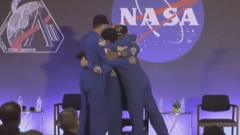
The successful return of the Artemis II crew—the four astronauts tasked with circling the lunar surface for the first time in over half a century—marks a significant shift from theoretical planning to physical reality. While the public celebrates the emotional weight of humans viewing "Planet Earth" from the depths of space, the industrial and geopolitical machinery behind this feat is under immense pressure. This is not the 1960s. We are no longer in a frantic sprint fueled by an open checkbook and Cold War desperation. Instead, we are witnessing a complex, precarious attempt to build a permanent off-world economy while navigating hardware delays, budget scrutiny, and a radical shift toward private-sector reliance.
NASA’s recent welcoming of the crew signifies that the Orion capsule and the Space Launch System (SLS) are finally ready for human occupancy. However, the path from a successful splashdown to a sustainable lunar presence is fraught with engineering hurdles that rarely make the evening news.
The Fragile Architecture of Modern Moon Missions
The Apollo missions were a masterpiece of vertical integration. NASA owned the hardware, the blueprints, and the schedule. The Artemis program functions as a sprawling, decentralized web of contractors and international partners. This structure is designed for longevity, but it creates a logistical nightmare where every component must fit perfectly despite being built by different entities with different profit motives.
At the center of this web is the Orion Multi-Purpose Crew Vehicle. While Orion has proven its ability to survive high-speed reentry through the atmosphere, the life support systems required to keep four people alive for weeks in deep space are exponentially more demanding than those used for short trips to the International Space Station. The thermal protection system, specifically the heat shield, remains a point of intense scrutiny. During the uncrewed Artemis I flight, the shield experienced unexpected charring and "liberation" of material. Engineers have spent months analyzing why the shield wore away unevenly, as a repeat of that phenomenon with humans on board is a risk the agency cannot afford to take.
The Problem of Weight and Power
Deep space transit requires a brutal trade-off between mass and capability. Every extra kilogram of oxygen or shielding requires a massive increase in fuel. Orion relies on the European Service Module, a critical piece of hardware provided by ESA that handles propulsion and power. This international dependency is a diplomatic victory but a technical challenge. If a single valve from a supplier in Germany fails, or if a software patch from a contractor in Colorado is buggy, the entire mission grinds to a halt. The margin for error is effectively zero.
The Looming Shadow of the Human Landing System
While the Orion capsule gets the glory, it cannot actually land on the moon. For that, NASA is betting everything on Starship, the massive reusable rocket being developed by SpaceX. This represents the first time the United States has outsourced its primary landing vehicle to a commercial entity.
The technical gap here is enormous. To get a crew from lunar orbit to the lunar surface, Starship needs to perform an orbital refueling maneuver that has never been attempted. Imagine a fleet of "tanker" rockets launching in rapid succession to fill a primary vehicle with cryogenic fuel while orbiting the Earth. If the refueling sequence fails, the astronauts in Orion stay in orbit, unable to descend. This dependency on a yet-to-be-proven refueling architecture is the single greatest bottleneck in the timeline for a lunar landing.
Critics argue that this approach is overly optimistic. They point to the history of aerospace development, where delays are the rule, not the exception. Yet, NASA has no "Plan B." The agency has pivoted so hard toward the commercial model that the success of the Artemis program is now inextricably linked to the success of a private company’s internal R&D cycle.
Radiation and the Human Cost
Low Earth Orbit (LEO) is relatively safe. The Earth’s magnetic field acts as a shield, deflecting the harshest solar and cosmic radiation. Once the Artemis crew leaves that protection, they enter the Van Allen radiation belts and the unpredictable environment of deep space.
We have limited data on the long-term effects of deep-space radiation on the human body. Apollo astronauts were only out for a few days; Artemis crews are expected to stay for weeks or even months. NASA is currently using "mannequins" equipped with thousands of sensors to map how radiation penetrates human tissue, particularly focusing on how it affects soft organs and bone marrow. The results of these studies will dictate how much lead or water shielding must be built into future habitats. If the radiation levels are higher than anticipated, the weight of the necessary shielding could make currently planned landers too heavy to function.
The Geopolitical Stakes of Lunar South Pole
The mission has shifted from "planting a flag" to "claiming a footprint." The destination for the upcoming landing is the Lunar South Pole, a region believed to contain vast deposits of water ice in permanently shadowed craters.
- Resource Extraction: Water isn't just for drinking. It can be broken down into hydrogen and oxygen to create rocket fuel, turning the moon into a "gas station" for the solar system.
- Strategic Positioning: The high ridges around these craters receive nearly constant sunlight, which is vital for solar power. There is only so much "prime real estate" at the South Pole.
- International Competition: China is aggressively pursuing its own lunar program with the goal of a crewed landing by 2030. The race for the South Pole is a race for the high ground of the 21st century.
This isn't just about science. It is about establishing a legal and physical precedent for how lunar resources are managed. The Artemis Accords—a set of non-binding principles designed to govern lunar exploration—are an attempt by the U.S. to set the rules of the road before other nations establish their own norms.
The Economic Reality Check
Space exploration is expensive, but the way we pay for it has changed. The "cost-plus" contracts of the past, where the government covered every expense plus a guaranteed profit for the contractor, are being replaced by "fixed-price" contracts. This forces companies to innovate or lose money.
However, this shift has led to friction. Traditional aerospace giants are struggling to compete with the speed of newer, more agile firms. This tension often plays out in the halls of Congress, where budget allocations are fought over with more intensity than the technical specifications of the rockets themselves. To keep the program alive, NASA must prove that Artemis is more than a vanity project; it must demonstrate a tangible return on investment, whether through technological spin-offs or the creation of a new lunar economy.
The "special thing" about being on Earth, as the astronauts noted, is the thin layer of atmosphere that keeps us alive. Replicating that environment in a vacuum 238,000 miles away is the most difficult engineering task in human history. It requires more than just bravery from the crew; it requires a sustained, decades-long commitment from a government that often struggles to plan beyond the next election cycle.
We are currently in the most dangerous phase of the program: the transition from the excitement of a successful test to the grueling, repetitive work of operational flights. The hardware is built, the crew is trained, and the targets are set. Now, the industry must prove it can execute this mission without the catastrophic failures that ended the Shuttle program. The moon is no longer a distant light in the sky; it is a construction site waiting for its first shift to arrive.
The machinery of exploration is moving, but the margin between a historic triumph and a multi-billion dollar setback is thinner than the hull of the Orion capsule itself.