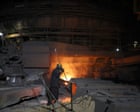
The survival of Scunthorpe’s primary steelmaking capacity is no longer a question of industrial policy but a high-stakes fiscal management problem. With the National Audit Office (NAO) projecting a taxpayer exposure exceeding £1.5 billion by 2028, the British government is effectively underwriting a private-sector transition from blast furnace (BF) technology to Electric Arc Furnaces (EAF). This intervention represents a fundamental shift in the UK’s industrial risk profile, moving from a market-led manufacturing sector to a state-subsidized "green" transition where the government bears the capital risk while the private owner, Jingye Group, retains the operational upside.
The core tension lies in the mismatch between the urgency of Net Zero targets and the economic viability of domestic steel production. To understand the scale of the impending £1.5 billion liability, we must decompose the crisis into three distinct pressure points: the carbon price squeeze, the capital expenditure (CapEx) gap, and the structural labor redundancy costs. If you enjoyed this article, you might want to read: this related article.
The Carbon Price Squeeze: A Forced Obsolescence
The primary driver for the current fiscal intervention is the escalating cost of the UK Emissions Trading Scheme (UK ETS). Scunthorpe’s traditional blast furnaces are among the highest-intensity carbon emitters in the country. Under the current regulatory framework, the cost of carbon credits acts as a regressive tax on legacy infrastructure.
- Emission Intensity: Blast furnaces require metallurgical coal to reduce iron ore, a process that inherently releases massive volumes of CO2.
- Marginal Cost Escalation: As free allowances for carbon emissions are phased out, the operational cost of a blast furnace becomes uncompetitive against imported steel from regions with laxer environmental standards or against domestic EAF production.
The government’s financial commitment is not merely an investment in new technology; it is a defensive payout to prevent the immediate collapse of the site under the weight of its own carbon liabilities. By 2028, the "business-as-usual" model for Scunthorpe would likely be insolvent solely based on carbon pricing, making the £1.5 billion figure a floor for the cost of intervention rather than a ceiling. For another look on this event, refer to the latest update from The Motley Fool.
The Capital Expenditure Gap: Transitioning to Electric Arc Furnaces
The proposed solution—replacing blast furnaces with Electric Arc Furnaces—requires a massive infusion of capital that Jingye Group has been reluctant to provide without state guarantees. This creates a "CapEx Gap" that the taxpayer is now being asked to fill.
The logic of EAF technology is technically sound but economically complex in the UK context. Unlike blast furnaces, EAFs melt scrap steel using electricity. This shifts the primary input from coal to power and scrap metal.
The Cost Function of EAF Adoption
The viability of this transition is governed by a three-variable cost function:
- Grid Connection and Power Pricing: The UK has historically suffered from higher industrial electricity prices compared to European and North American competitors. Without a dedicated industrial energy strategy, an EAF in Scunthorpe remains at risk of high operational expenditure (OpEx), even if the initial CapEx is subsidized.
- Scrap Supply Chain Integrity: The UK is a net exporter of scrap steel. Moving to an EAF-centric model requires retaining high-quality scrap domestically, which may necessitate export taxes or new procurement mandates that could distort the broader market.
- Product Specification Limits: EAFs have traditionally struggled to produce the ultra-high-purity steel required for specific automotive and aerospace applications. If Scunthorpe cannot meet these specifications, the move to EAF represents a retreat into lower-margin commodity steel, further weakening the long-term ROI for the taxpayer.
The £1.5 billion estimate includes not just the hardware of the furnaces, but the necessary infrastructure upgrades to the National Grid to support the massive electrical load required by a modernized plant. This hidden infrastructure cost is a significant portion of the total fiscal burden.
The Structural Labor Redundancy Cost
A critical omission in many surface-level analyses is the relationship between technology shifts and headcount requirements. Blast furnace operations are labor-intensive, supporting thousands of high-skill jobs in North Lincolnshire. EAFs, by contrast, are significantly more automated and require a fraction of the workforce.
The government’s £1.5 billion exposure is partially an insurance policy against a localized economic depression. The "social cost" of a Scunthorpe closure includes:
- Direct Redundancy Payments: Statutory and enhanced packages for the thousands of workers whose roles will become obsolete during the transition.
- Welfare Dependency: The long-term cost of supporting a workforce in a region where steelmaking is the primary high-wage employer.
- Supply Chain Contraction: For every direct job at British Steel, an estimated 3 to 4 jobs exist in the local and national supply chain. The transition to EAF simplifies the supply chain, which, while efficient for the company, is destructive to the local tax base.
The NAO’s figure likely accounts for the "support packages" necessary to manage this downsizing. This creates a paradox: the taxpayer is paying to modernize a facility that will ultimately employ fewer taxpayers.
The Strategic Misalignment: Ownership vs. Control
A primary risk factor identified by analysts is the lack of equity the UK government receives in exchange for its £1.5 billion commitment. In a standard private equity or venture capital framework, a £1.5 billion injection would command significant control or a majority stake. In the Scunthorpe case, the funds are structured as grants or conditional loans, leaving the asset in the hands of a foreign entity, Jingye Group.
This creates a moral hazard. If the steel market softens or electricity prices spike, Jingye retains the option to mothball the site, regardless of the taxpayer’s "investment." The government is essentially buying time, not necessarily a guaranteed industrial future.
Known Facts vs. Educated Hypotheses
To maintain analytical rigor, we must separate the current fiscal reality from the projected outcomes:
- Known Fact: The UK government has already committed hundreds of millions in principle for EAF transitions at both Port Talbot (Tata Steel) and Scunthorpe (British Steel).
- Known Fact: The UK steel industry’s carbon footprint is a primary target for national Net Zero compliance.
- Educated Hypothesis: The £1.5 billion figure is likely an underestimate. Historical precedents for large-scale industrial transitions suggest that "integration costs"—the unforeseen hurdles in grid connectivity, environmental remediation of the old site, and retraining—frequently result in 20-30% cost overruns.
- Educated Hypothesis: Without a radical restructuring of UK industrial energy pricing, the newly built EAFs will require ongoing operational subsidies to compete with Chinese or Indian imports.
The Three Pillars of a Viable Steel Strategy
If the goal is to ensure the £1.5 billion is not a sunk cost, the government must move beyond mere capital grants and address the structural bottlenecks that make British steel production difficult.
1. Energy Decoupling
The government must decouple industrial electricity prices from the price of natural gas. EAFs are essentially "giant kettles." If the price of power remains tethered to volatile gas markets, the taxpayer-funded furnaces will be "white elephants"—modern assets that are too expensive to run.
2. Mandatory Domestic Content
A "Green Steel" mandate for UK infrastructure projects—such as HS2, nuclear power plants, and offshore wind farms—is the only way to guarantee a floor for demand. Without a captive market for high-cost, low-carbon British steel, the Scunthorpe site will be at the mercy of global spot prices, which do not currently value the "green" premium.
3. Circular Economy Protectionism
The UK must treat its scrap steel as a strategic national resource. Allowing high-quality scrap to be exported while subsidizing EAFs to melt that very scrap is an inefficient circularity. Policies to restrict scrap exports or incentivize domestic processing are necessary to lower the OpEx of the new Scunthorpe furnaces.
The Fragility of the Jingye Agreement
The relationship between the UK government and Jingye Group is a bottleneck for long-term stability. The 2020 acquisition of British Steel was heralded as a rescue, but the current demand for £1.5 billion suggests that the initial business plan was insufficient for the regulatory environment of the mid-2020s.
The government faces a "Sunk Cost Fallacy" risk. Having already invested significant political and financial capital into saving the site, they are increasingly pressured to meet every new funding request to avoid the total loss of previous investments. This creates an asymmetric negotiation power where Jingye can leverage the threat of closure to extract further concessions.
The path forward requires a transition from "rescue mode" to "contractual rigor." The £1.5 billion should be disbursed through a phased, milestone-based framework:
- Phase I: Grid Readiness. Funding is released only when the National Grid confirms the capacity to power the EAF at industrial rates.
- Phase II: Technology Integration. Payment is tied to the physical decommissioning of the high-emission blast furnaces.
- Phase III: Employment Retention. A "Clawback" mechanism must be in place. If Jingye reduces the workforce below a negotiated threshold within the first five years of EAF operation, a portion of the £1.5 billion must be returned to the Treasury.
The current trajectory suggests that without these safeguards, the UK taxpayer is not buying a steel industry, but rather paying for the controlled demolition of a 20th-century industrial giant. The strategic priority must be to ensure that the "Green Steel" produced at Scunthorpe has a viable path to market, or the £1.5 billion will merely be the first installment in an endless series of bailouts.
Establish a formal "Industrial Energy Price Cap" specifically for EAF operators and implement a 15% scrap-metal export levy to secure the domestic supply chain before the first furnace is commissioned. Without these two tactical interventions, the capital investment will fail to yield a self-sustaining business.