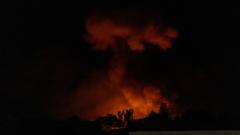
The standard news report on a military depot explosion follows a predictable, lazy script.
An ammunition dump in a place like Bujumbura or a similar global capital goes up in smoke. Windows shatter. Civilians die. Within hours, the media rushes to print the same tired narrative: it was an accident, the storage was substandard, and the government is incompetent.
They treat these events like isolated tragedies born of pure negligence. They are dead wrong.
By focusing entirely on the "accidental" nature of these blasts, analysts and journalists are missing the brutal reality of modern asymmetric conflict and the physics of aging munitions. We are looking at a massive, systemic failure in how the world understands weapons stockpiles in developing nations.
Stop asking how the explosion happened. Start asking why we expected it not to.
The Illusion of the Accidental Detonation
When a competitor runs a headline about witnesses hearing explosions at a depot, they are reporting the effect while completely misdiagnosing the cause. The typical analysis chalks it up to "poor storage conditions" or "human error."
Let's dismantle that premise.
I have walked through ordnance disposal sites where munitions from the 1970s are stacked like cordwood in 100-degree heat. To call their detonation an "accident" is like calling a sunburn after ten hours on the beach a surprise. It is a mathematical certainty.
Here is what the standard reporting misses about the chemistry of disaster:
- Propellant Degradation: Single-base and double-base propellants use nitrocellulose. Over time, this compound breaks down and releases heat. If that heat cannot dissipate, it autocatalyzes. The pile gets hotter until it cooks off.
- The Stabilizer Trap: Munitions are manufactured with chemical stabilizers to prevent this exact breakdown. But stabilizers are consumable. Once they are depleted, the countdown begins.
- Climate Reality: Many of these depots are in tropical or subtropical zones. High ambient temperatures exponentially accelerate the depletion of those stabilizers.
When you leave aging Soviet-era or Western-surplus artillery shells in a concrete shed in Central Africa without climate control, you are not maintaining a stockpile. You are building a massive, slow-burning fuse. Calling the result an "accident" absolves the international community of its role in dumping surplus hardware into regions ill-equipped to maintain it.
The Asymmetric Warfare Reality Nobody Wants to Admit
Here is the second massive blind spot in the traditional news coverage. We assume that because a government calls an explosion an accident, it actually was one.
In modern conflict, depot explosions are often highly successful, low-cost operations executed by rebel groups or foreign intelligence services.
Imagine a scenario where a drone weighing less than five pounds, carrying a small incendiary payload, drops onto a roof of a munitions shed. It costs the attacker $500. It destroys $50 million in government assets, kills troop morale, and terrorizes the local populace.
Will the government admit they were infiltrated and outmaneuvered by a cheap drone? Absolutely not. They will claim a private mishandled a crate or that electrical wiring sparked. It saves face.
The media eats it up because "incompetent military blows up its own town" fits a comfortable narrative. "Sophisticated asymmetric attack bypasses millions in security" is a much harder story to write, requiring actual investigative work instead of just quoting "witnesses."
By instantly defaulting to the negligence theory, we blind ourselves to the evolving tactics of urban sabotage. We are fighting yesterday's PR war while ignoring today's kinetic reality.
The True Cost of Weapon Dumping
Let's look at the data that the armchair generals ignore.
The Small Arms Survey has tracked unplanned explosions at munitions sites for decades. They have documented hundreds of incidents in over 100 countries. This is not a Burundi problem. This is not a "developing world" problem. It is a global inventory problem.
Major military powers routinely sell or "donate" their aging stockpiles to smaller nations as part of security cooperation agreements. It looks great on paper. The donor nation clears out expensive-to-dispose-of ordnance and gains a political ally. The recipient nation gets a ready-made military capability.
But here is the catch. The recipient rarely gets the specialized training, the surveillance equipment, or the chemical testing kits required to monitor propellant stability. They get the bullets, but not the manual on how to keep them from exploding spontaneously in ten years.
We are treating deadly ordnance like it is non-perishable food. It is not. It has a shelf life. When that shelf life expires, it becomes a liability to the very civilians it is supposed to protect.
People Also Ask: Dismantling the Ignorance
To truly understand this issue, we have to look at what the public is asking and tear down the flawed premises of those questions.
Why can't they just store ammo safely?
This question assumes that "safe storage" is just a matter of locking the door and putting up a "No Smoking" sign. True ammunition management requires continuous chemical surveillance. You have to pull random samples from ammunition lots and test the stabilizer levels in a laboratory.
If a nation cannot afford basic healthcare for its citizens, it is not going to fund a high-tech chemical laboratory to test artillery shells. "Safe storage" in these contexts is a luxury that simply does not exist.
Who is to blame for civilian casualties in these blasts?
The media loves to blame the local commander or the defense minister. That is too easy.
The blame lies squarely with the international arms transfer system. If you supply weapons without supplying the infrastructure to maintain and eventually decommission them, you are complicit in the eventual disaster. We need to stop viewing arms sales as one-and-done transactions. They are long-term hazardous material management projects.
How do we stop these explosions?
The conventional wisdom says: "Build better bunkers."
Wrong. Better bunkers just contain the blast slightly better, or worse, they create more confined pressure, leading to a bigger detonation if venting fails.
The only real solution is aggressive, funded demilitarization. We need to pay to destroy old ammunition. But destroying ammo does not win votes or project power. Buying new ammo does. Until that incentive structure changes, the depots will keep blowing up.
The Brutal Solution
I have spent years looking at the aftermath of failed logistics. I have seen what happens when a warehouse full of ammonium nitrate or aging mortars decides it has had enough of the heat.
If we want to stop killing civilians in depot explosions, we have to adopt a radical shift in policy.
- Mandatory Expiration Dates on Arms Transfers: No nation should be allowed to donate or sell munitions without a hard, legally binding expiration date based on the climate of the recipient country.
- The "Take-Back" Infrastructure: Any country that sells advanced munitions must be legally required to take back and destroy those munitions at the end of their safe lifespan, at their own cost.
- Assume Sabotage First: Security forces need to stop treating depots like static warehouses and start treating them like the primary targets they are.
This approach has downsides. It will make arms deals much more expensive. It will slow down the transfer of weapons to allies. It will require massive logistical footprints to return expired ordnance across oceans.
But the alternative is what we see in the news right now. Smoldering ruins, dead bystanders, and a chorus of clueless analysts wondering why the explosives exploded.
The competitor article wants you to feel bad for the victims and blame a local government. I want you to be furious at a global system that treats high explosives like they are inert piles of iron.
Stop reading the play-by-play of the disaster. Understand the physics and the geopolitics driving it.
The depot didn't just explode. It was designed to.