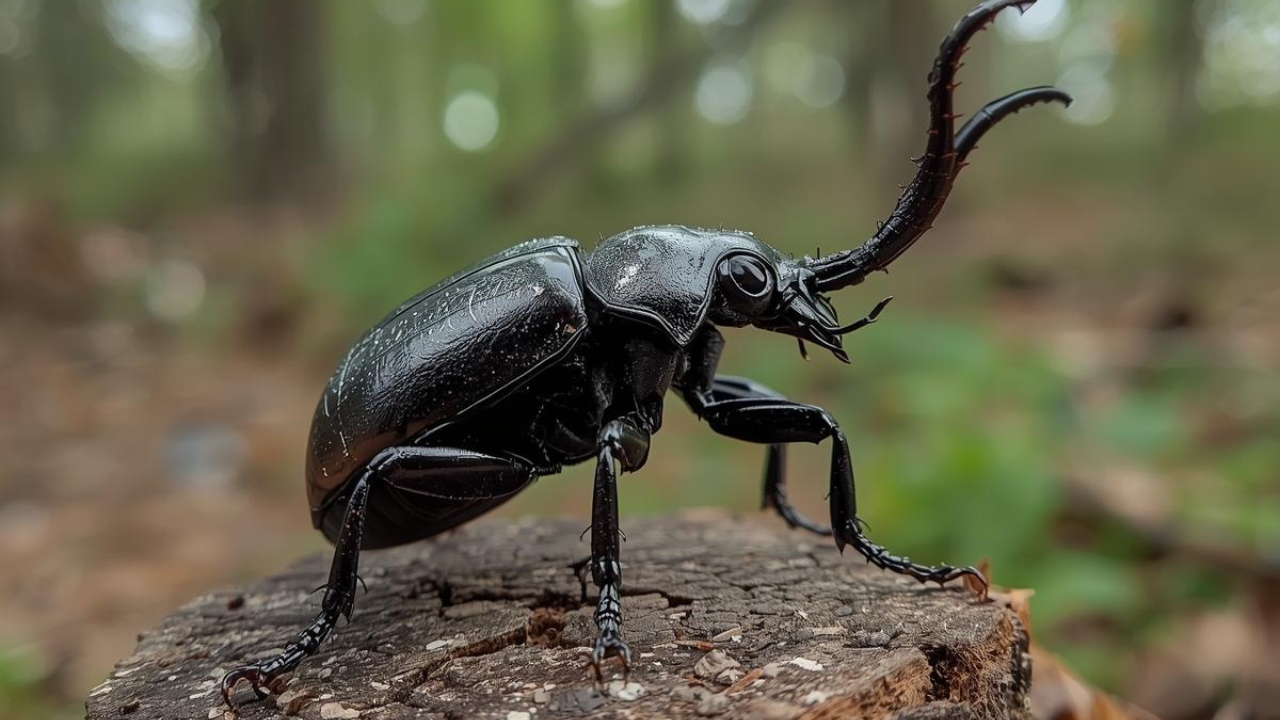
The diabolical ironclad beetle (Phloeodes diabolicus) represents a terminal point in evolutionary structural engineering, capable of withstanding compressive forces up to 149 Newtons—approximately 39,000 times its own body weight. This capacity exceeds the crushing threshold of a standard automobile tire by a factor of nearly ten when normalized for the insect's surface area. The survival of this organism is not a result of "toughness" in the traditional sense, but rather a sophisticated suite of hierarchical mechanical interlocks and energy-dissipating sutures that solve the fundamental engineering problem of high-load distribution in brittle-ductile interfaces.
The Tri-Layer Defense Strategy
The exoskeleton of the ironclad beetle functions as a specialized composite material. To understand its resilience, one must categorize the defense into three distinct mechanical layers: the epicuticle, the exocuticle, and the endocuticle. While most beetles utilize these layers for basic protection and hydration, P. diabolicus has modified the chemical composition and geometry of these layers to prioritize load-bearing.
- Chitin-Protein Matrix Densification: The primary load-bearing material is a chitin-protein matrix. In the ironclad beetle, the concentration of protein is significantly higher than in flighted counterparts, leading to a denser, more rigid architecture.
- Laminated Microstructure: The endocuticle consists of highly organized, laminated layers. This lamination prevents crack propagation. When a force is applied, the energy is forced to travel through a labyrinthine path, losing kinetic energy at each layer interface.
- Mineralization Gradients: There is a clear gradient of mineralization from the exterior to the interior. The outer shell is hyper-mineralized to resist puncture, while the inner layers remain relatively compliant to absorb the energy of a slow, crushing force.
The Medial Suture: A Masterclass in Interlocking Geometry
The most critical innovation of the ironclad beetle is the medial suture, located where the two halves of the elytra (wing covers) meet. Since this beetle has lost the ability to fly, its elytra are permanently fused. This fusion does not create a rigid, breakable seam; instead, it utilizes a "jigsaw puzzle" geometry known as a penduncular interlocking suture.
Geometry of the Interlocks
The suture is composed of multiple blades or "lobes" that fit into corresponding sockets. The geometry of these lobes is elliptical, which is a specific evolutionary choice to minimize stress concentrations. A square or sharp-angled joint would create a "stress riser," a point where a crack is likely to initiate under pressure. The elliptical curve ensures that the load is spread across the entire surface area of the joint.
Toughening Mechanisms
The suture does not rely on static strength alone. Under extreme load, the suture undergoes a process called delamination.
- The lobes are composed of layers.
- As the beetle is compressed, these layers begin to peel apart slightly rather than snapping.
- This controlled "failure" absorbs a massive amount of energy, effectively acting as a mechanical shock absorber.
- Once the pressure is removed, the elastic nature of the chitin allows the lobes to return to their original configuration.
Lateral Support and Internal Compliance
While the medial suture handles vertical compression, the lateral edges of the beetle use a different mechanical strategy to manage shear forces. The interface between the dorsal (top) and ventral (bottom) shells is not uniform.
The front of the beetle, housing the vital organs, features a highly rigid, "zipped" connection. This prevents any deformation that might crush the heart or central nervous system. Moving toward the posterior, the connection becomes increasingly flexible. This gradient of stiffness allows the rear of the beetle to compress and "give" under weight, shifting the load away from critical biological systems. This is an example of spatially tuned stiffness, a concept used in modern aerospace engineering to protect sensitive components within a fuselage.
Material Performance Benchmarking
To quantify the superiority of the ironclad beetle's architecture, we must compare its performance against standard biological and synthetic benchmarks.
- Specific Strength: The ratio of the beetle's crush resistance to its mass outperforms most carbon-fiber-reinforced polymers used in automotive racing.
- Fracture Toughness: The ability of the suture to delaminate without total structural failure gives it a fracture toughness rating significantly higher than that of engineered ceramics.
- Deformation Capacity: The beetle can sustain a 30% reduction in its total body height without sustaining permanent internal damage.
Engineering Applications: From Insects to Infrastructure
The structural logic of P. diabolicus is currently being ported into material science through biomimetic design. The primary bottleneck in joining dissimilar materials—such as metal to carbon fiber—is the point of connection. Mechanical fasteners like bolts create stress points, while adhesives often fail under shear.
Applying the ironclad beetle's suture geometry to these joints offers a third path: Structural Interlocking.
- Turbine Blade Attachment: Utilizing elliptical, layered lobes to attach turbine blades to rotors could reduce the risk of catastrophic failure from centrifugal stress.
- Protective Gear: Helmets and body armor designed with "sliding" sutures can absorb impacts more efficiently than solid shells by converting linear impact into internal frictional energy.
- Aerospace Skin: Deploying spatially tuned stiffness across the skin of a spacecraft could allow for localized flexibility during the thermal expansion of re-entry while maintaining rigid protection for the crew cabin.
The limitation of this technology lies in the manufacturing process. Creating the microscopic, multi-layered "blades" found in the beetle requires high-precision 3D printing or advanced chemical vapor deposition. Current industrial methods struggle to replicate the hierarchical complexity of the beetle's chitin-protein matrix at a macro scale.
Strategic Implementation of Suture Logic
Organizations aiming to leverage these biological principles must shift focus from "material strength" to "architectural toughness." The goal is not to build a part that cannot break, but to design a part that fails gracefully.
The first step in any industrial application is the mapping of the load-to-failure curve. Engineers must identify where a component can afford to delaminate to save the system's core. By mimicking the ironclad beetle's medial suture, we can move toward a paradigm of "resilient failure," where structures maintain their integrity even after exceeding their initial design limits.
Focus development efforts on gradient-based manufacturing. The secret to the ironclad beetle is not found in a single material, but in the transition between materials of varying stiffness. Mastery of these interfaces will be the defining metric of next-generation structural engineering.