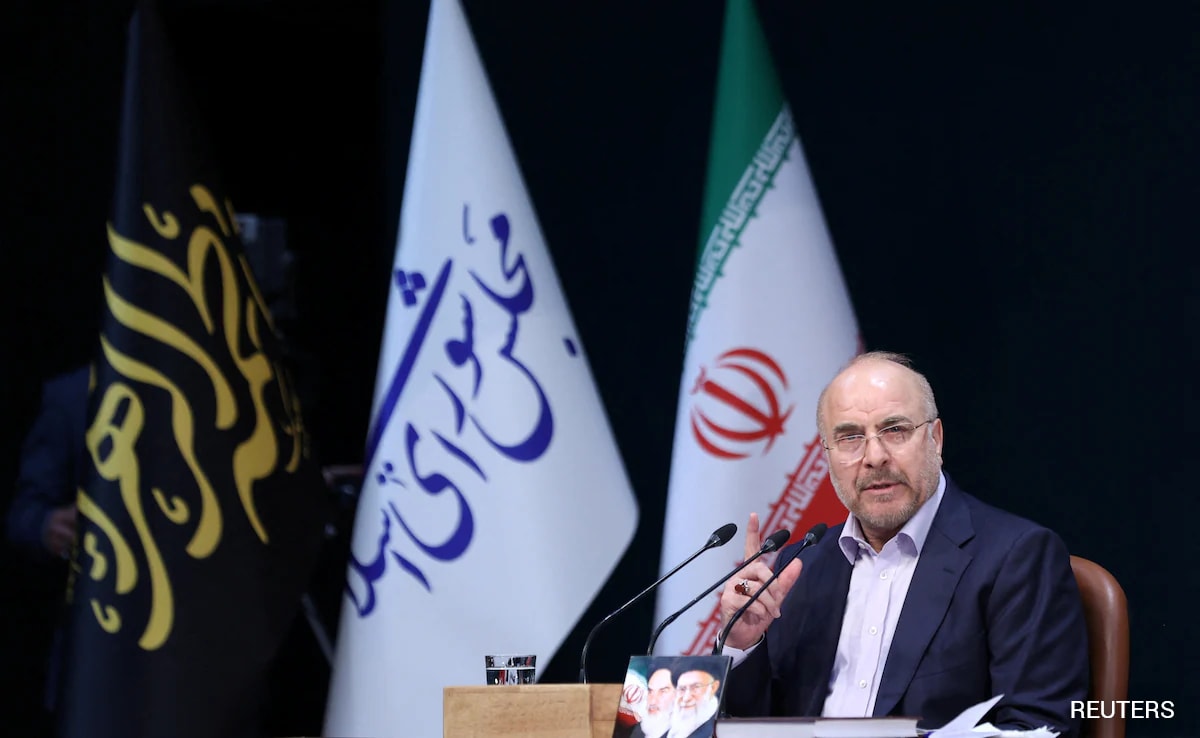
The Iranian leadership is sounding an alarm that has echoed across the Strait of Hormuz for decades, yet the current frequency is sharper, louder, and more desperate. Mohammad Bagher Ghalibaf, the Speaker of Iran’s Parliament, recently declared that "enemies" are positioning themselves to occupy the disputed islands of Abu Musa, Greater Tunb, and Lesser Tunb. To the casual observer, this looks like standard regional posturing. To those who track the movement of tankers and the shifting alliances of the Gulf Cooperation Council (GCC), it is a signal that the status quo in the world’s most vital energy artery is nearing a breaking point.
This isn't just about three small patches of land in the Persian Gulf. It is about the legal and physical control of the shipping lanes that carry twenty percent of the global petroleum supply. If Iran loses its grip on these islands, it loses its primary lever of strategic depth against the West and its neighbors. The "enemy" Ghalibaf refers to isn't just a military force, but a growing diplomatic consensus between the United Arab Emirates (UAE) and global powers like Russia and China—nations Iran previously considered its reliable anchors.
The Strategic Geometry of the Strait
To understand the panic in Tehran, you have to look at a map, not a manifesto. The three islands sit at the mouth of the Strait of Hormuz. They act as stationary aircraft carriers. Whoever controls them controls the radar signatures and the physical passage of every deep-water vessel entering or exiting the Gulf.
Iran has occupied these islands since 1971, moving in just as British forces were withdrawing from the region. For years, the UAE has maintained a persistent, peaceful claim to them, often relegated to the back pages of diplomatic briefings. That changed when the UAE began successfully lobbying its trade partners to include the island dispute in official joint statements. When China—Iran's biggest oil buyer—and Russia—Iran's primary military collaborator—signed onto statements supporting a "peaceful resolution" to the dispute, the floor dropped out from under the Iranian Foreign Ministry.
Tehran views "peaceful resolution" as code for international arbitration, a process they believe they would lose. Ghalibaf’s rhetoric about "occupation" is a preemptive strike. By framing a legal dispute as a military threat, Iran is signaling that any attempt to change the administrative reality of the islands will be met with kinetic force.
The Sovereignty Trap
The islands are a nightmare of overlapping history. The UAE bases its claim on the historical administration by the Al Qasimi sheikhs of Sharjah and Ras Al Khaimah. Iran points to maps from the era of the Persian Empire and a 1971 Memorandum of Understanding that allowed for Iranian troops on Abu Musa while maintaining shared administrative rights for Sharjah.
But history is being paved over by modern necessity. The UAE has transformed itself into a global logistics and financial hub. For Dubai and Abu Dhabi, the presence of Iranian military hardware on islands just miles from their coastline is a permanent tax on their national security and insurance premiums.
The Iranian perspective is driven by a siege mentality that is not entirely unfounded. They see the growing military cooperation between the GCC and the United States, alongside the Abraham Accords, as a tightening noose. If the islands were to fall under UAE control or become internationalized, Iran’s "choke point" capability—the ability to shut down the Strait in the event of a war—evaporates.
The Russian and Chinese Pivot
The most stinging element of this crisis for Tehran is the perceived betrayal by its allies. In the last year, both Moscow and Beijing have prioritized their massive economic ties with the Arab states over the ideological sensibilities of the Islamic Republic.
China needs a stable Gulf to fuel its economy. It does not want a volatile Iran holding a permanent knife to the throat of global shipping. By siding with the UAE’s call for negotiations, Beijing is telling Tehran that its "look to the east" policy does not grant it a blank check for regional assertiveness.
Russia, bogged down in its own territorial conflicts, finds itself in a precarious spot. It needs Iranian drones and ballistic missiles, but it also needs the financial lifelines provided by Gulf banks and the diplomatic cover provided by neutral Arab states. When Moscow signed a joint statement with the GCC regarding the islands, the Iranian government summoned the Russian ambassador—a rare public crack in an alliance that is usually presented as unbreakable.
Economic Consequences of a Hot Dispute
If this moves beyond rhetoric, the global economy will feel it instantly. We are not talking about a minor spike in gas prices. We are talking about the total disruption of the "Just-in-Time" energy supply chain.
Shipping insurance is the first domino. The moment Iran holds military exercises centered on "defending against occupation," Lloyds of London and other insurers reclassify the zone. The cost of moving a barrel of oil rises, not because of a shortage, but because of the risk of seizure or accidental engagement.
Infrastructure investment is the second. The UAE is currently positioning itself as a bridge between the East and West through the India-Middle East-Europe Economic Corridor (IMEC). Stability is the currency of this project. Iran knows that by keeping the island dispute "hot," it creates enough uncertainty to hamper the long-term regional integration that would otherwise leave it isolated.
The Military Reality on the Ground
Iran has spent the last decade fortifying these islands. They are not just outposts; they are hardened nodes in a sophisticated "Anti-Access/Area Denial" (A2/AD) network.
- Underground Silos: Satellite imagery has long suggested the presence of "missile cities" carved into the rock.
- Fast Attack Craft: The Islamic Revolutionary Guard Corps (IRGC) Navy operates swarms of high-speed boats from these locations, capable of harassing tankers within minutes of an order.
- Drone Launchpads: The islands provide the perfect range for short and medium-range loitering munitions to cover the entire width of the Strait.
Ghalibaf’s warning isn't just for the neighbors; it’s for the domestic audience. As Iran faces internal economic pressure and a looming succession crisis within its leadership, nothing creates unity like a perceived threat to "sacred soil." The islands have become a litmus test for Iranian nationalism. To give up even a centimeter of Abu Musa would be seen as a fatal weakness for the current regime.
A Failed Path to De-escalation
There is no easy exit. The UAE cannot drop its claim without looking like it is bowing to Iranian hegemony. Iran cannot negotiate without admitting its 1971 "occupation" is up for debate.
The UN has been a ghost in this process. International law favors the status quo until a conflict breaks out, and then it struggles to catch up. The primary danger now is a "gray zone" incident—a commercial vessel getting caught in a live-fire exercise or a drone malfunction that hits a sensitive target.
Ghalibaf and the IRGC high command are betting that by raising the specter of "occupation," they can scare the international community into pressuring the UAE to drop the issue. But the UAE has found a new level of confidence. They are no longer a junior partner in regional security; they are a primary architect of the new Middle East.
The Breaking Point
The world treats the Persian Gulf like a gas station, but it is actually a powder keg with a very short fuse. When the Speaker of the Iranian Parliament warns of an impending occupation, he is telling the world that Iran is ready to fight for three tiny islands that most people couldn't find on a map.
The move toward internationalizing the dispute has backfired in terms of immediate stability. Instead of forcing Iran to the table, it has pushed the hardliners into a defensive crouch. They are now looking for an excuse to prove their relevance.
The real danger isn't a planned invasion of the islands by the "enemies" Ghalibaf fears. The danger is a desperate Iranian leadership deciding that the only way to protect their claim is to start the very conflict they say they are trying to prevent. The Strait of Hormuz is narrowing, not geographically, but politically, and there is very little room left for error.
Every shipment of oil passing through the Strait today is a gamble on the restraint of a regime that feels increasingly backed into a corner by its own allies. If you want to know where the next global shock will come from, stop looking at the borders of Europe and start looking at the rocky shores of Abu Musa.