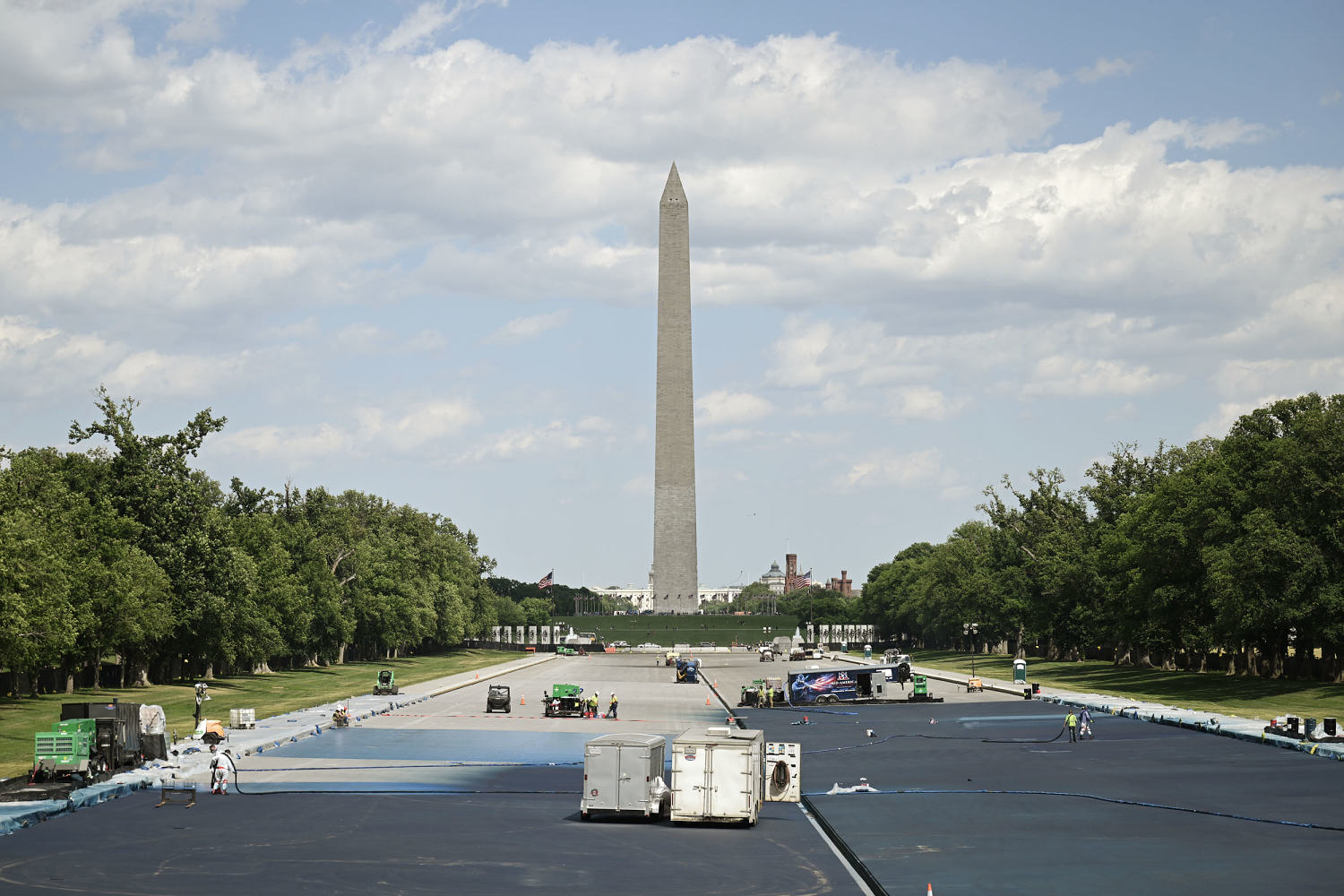
The Lincoln Memorial Reflecting Pool is not supposed to be blue.
If you stand at the edge of that long, rectangular expanse of water, you are standing at the epicenter of a very specific kind of American silence. On a clear day, the water acts as a dark, liquid mirror. It doesn't draw attention to itself. Instead, it vanishes. It yields. It allows the heavy, white marble of the Lincoln Memorial to descend into the depths, creating a twin monument that exists only in reflection. This is by design. Henry Bacon, the architect, understood that the power of the site lay in its stillness. The water was meant to be a void, a quiet gray-green space where the sky and the stone could meet without interference.
But there is a new vision for this space, and it involves a bucket of paint.
The Trump administration recently moved forward with a plan to strip the pool of its natural, somber palette. The goal is simple: paint the concrete floor of the pool "American Flag Blue." The logic behind the decision is rooted in a desire for vibrancy. Proponents argue that the current state of the pool—often murky, plagued by algae, and stained by the natural decomposition of organic matter—looks "dirty" on camera. They want a crisp, cinematic pop of color that screams patriotism from a satellite view.
They want the water to look like a postcard.
A coalition of preservationists, historians, and local citizens has responded with a lawsuit. To them, this isn't just a dispute over a color palette. It is a fight over the soul of a national monument. They argue that changing the color of the pool is a fundamental alteration of a historic landmark, a violation of the laws meant to protect the aesthetic integrity of the National Mall.
The Ghost in the Mirror
Consider a hypothetical visitor named Elias. Elias is a veteran who comes to the Mall once a year. He doesn't come for the crowds or the food trucks. He comes for the perspective. When Elias stands at the base of the Lincoln Memorial and looks toward the Washington Monument, he sees the reflection of the obelisk piercing the water.
In its current state, the water is deep. It feels like it has no bottom. This depth is an illusion created by the dark, unpainted concrete. Because the floor of the pool is dark, the light doesn't bounce back up. It gets swallowed. This allows the surface to act as a perfect mirror for the sky.
Now, imagine Elias standing there after the "American Flag Blue" makeover.
Suddenly, the illusion of depth is gone. Light hits the bright blue paint on the bottom and reflects upward, turning the water into a glowing, turquoise rectangle. It no longer looks like a mirror; it looks like a swimming pool. The Washington Monument no longer reflects against a dark abyss. It sits on top of a bright blue slab.
The weight of the place evaporates. The gravitas is replaced by something that feels synthetic, something designed for a television broadcast rather than a human soul.
The Cost of "Clean"
The administration's push for the change is framed as a matter of maintenance and pride. The Reflecting Pool is notoriously difficult to keep clean. Wind-blown debris, bird droppings, and algae blooms frequently turn the water into a pea-soup consistency. In their view, a bright blue floor would mask some of these imperfections, making the water appear "cleaner" even when it isn't.
It is an exercise in optics.
However, the preservationists point to a different reality. Painting the pool creates a massive, recurring maintenance liability. Paint in a body of water that size—over 2,000 feet long—does not stay pristine. It chips. It bubbles. It flakes off in the sun and reacts with the chemicals used to treat the water. Within a few seasons, the "American Flag Blue" wouldn't look like a flag at all; it would look like a weathered garage floor.
The lawsuit alleges that the administration bypassed the necessary reviews from the Commission of Fine Arts and the National Capital Planning Commission. These bodies exist specifically to prevent "improvements" that actually degrade the historical value of our shared spaces. They are the gatekeepers against the whims of any single administration that wants to leave a literal mark on the landscape.
A History of Subtlety
The Reflecting Pool has been the stage for the most significant moments in the American story. It was here that 250,000 people gathered for the March on Washington in 1963. It was here that the image of Dr. King was doubled in the water, his voice echoing off the surface.
During those moments, the water didn't need to be blue. It didn't need to be loud. Its power came from its neutrality. It provided a sense of infinite scale. When you stand there, you are meant to feel small. You are meant to feel the crush of history.
By painting the floor a bright, patriotic hue, the government is essentially adding a permanent "filter" to a historic site. It is the architectural equivalent of putting an Instagram filter on the Gettysburg Address. It assumes that the public cannot appreciate the raw, natural, and sometimes messy reality of a historic site without it being color-coded for their convenience.
The Invisible Stakes
We live in an era where the visual is everything. If it doesn't look good in a thumb-sized square on a smartphone, it is often deemed a failure. The push to paint the pool is a symptom of this mindset. It prioritizes the "shot" over the "experience."
But the Mall is not a movie set.
The preservation group behind the lawsuit understands that once you change the visual language of a monument, you change how people interact with it. If the pool becomes a giant blue rectangle, people will treat it differently. The hushed tones of the Lincoln Memorial might give way to something more casual, more recreational. The physical space dictates the emotional response.
There is a certain irony in calling the color "American Flag Blue." The flag itself represents a set of ideals—justice, sacrifice, and the slow, difficult work of democracy. Those ideals are reflected in the somber, quiet dignity of the Mall’s original design. Forcing a bright color onto the bottom of a pool doesn't make the space more American. It just makes it louder.
The court will eventually decide the fate of the concrete. They will pore over environmental impact statements and historic preservation statutes. They will argue about shades of pigment and the durability of industrial coatings.
But for the people who walk the perimeter of the water at dawn, the stakes are much simpler. They are looking for the reflection. They are looking for that moment when the world doubles itself in the dark water, creating a space for contemplation that doesn't require a label or a bright coat of paint.
The water should stay dark. The sky should be allowed to do the talking.
If we lose the mirror, we lose the ability to see ourselves in the context of the giants who stand at either end of the park. We are left with nothing but a blue floor and a shallow view of our own history.