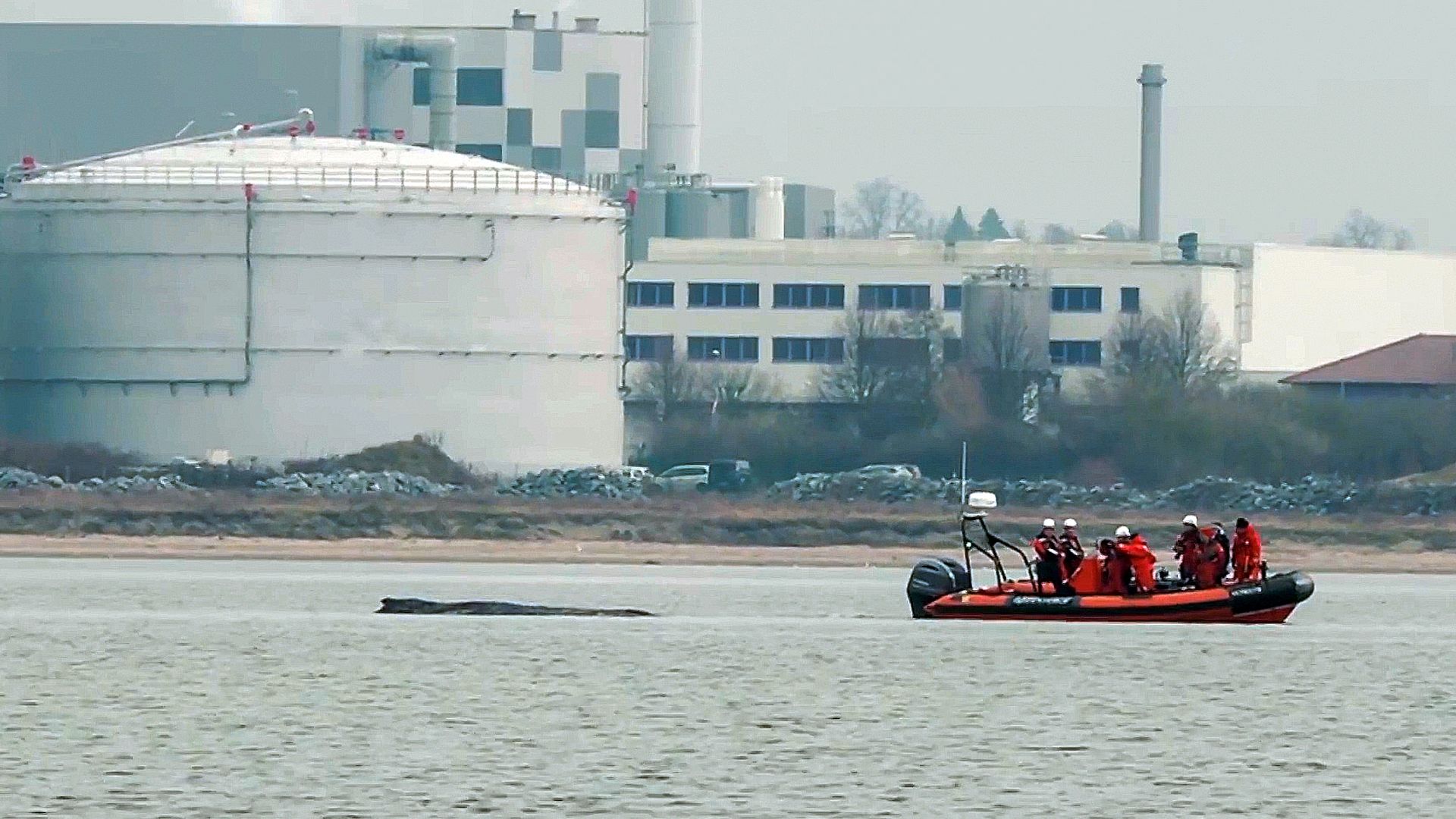
The sight of a fifteen-meter whale thrashing in the shallow, brackish waters of the Baltic Sea makes for a viral news clip, but it represents a profound failure of both biological instinct and human intervention. Last week, a fin whale was "successfully" towed to deeper water after grounding itself on a sandbar. Within forty-eight hours, the same animal was found stuck again, miles away, its skin sloughing off and its breathing labored. This is not a streak of bad luck. It is a biological death sentence that we are prolonging under the guise of mercy.
The Baltic Sea is a physical cage for large cetaceans. For an animal evolved to navigate the deep, high-salinity canyons of the Atlantic, entering the Skagerrak and Kattegat straits is the beginning of a terminal descent. When these giants take a wrong turn, they don't just lose their way; they lose their ability to survive. The recent re-stranding of this whale exposes a hard truth that maritime authorities and rescue groups often gloss over to maintain public support. We are not saving these animals. We are merely dragging out their agony.
The Salinity Crisis and the Buoyancy Trap
To understand why a rescued whale returns to the beach, you have to look at the chemistry of the water. The Baltic is one of the largest bodies of brackish water on Earth. Its salt content is significantly lower than the Atlantic Ocean. This is a critical problem for a multi-ton mammal.
Whales rely on the high density of saltwater to help support their massive weight. In the fresher, less dense water of the Baltic, they lose a portion of their natural buoyancy. They have to work harder just to stay afloat. This leads to rapid physical exhaustion. Imagine trying to run a marathon in a suit of lead armor while breathing through a straw. That is what a fin whale experiences once it passes the Danish islands.
By the time a whale is spotted near a beach, it is usually suffering from crush syndrome. When a whale’s body is no longer supported by water, its own weight collapses its internal organs and restricts blood flow to the muscles. This creates a buildup of toxins. Even if you tow that whale back to "deep" water, the damage is already done. The toxins are circulating. The kidneys are failing. The animal is disoriented, not because it forgot where the ocean is, but because its brain is being poisoned by its own dying tissue.
The Echo Chamber Effect
Navigation for a whale is a symphony of sound. They use echolocation to "see" the world around them, bouncing low-frequency signals off the sea floor and continental shelves. The Baltic Sea floor is a nightmare for this system. It is shallow, sandy, and relatively flat compared to the deep-sea trenches the animals are built for.
When a whale enters these waters, its sonar hits a "soft" bottom that absorbs sound rather than reflecting it clearly. This creates a sensory vacuum. The whale becomes functionally blind. It wanders into bays and estuaries because it cannot distinguish between the open sea and a coastal dead-end.
Rescue teams often focus on the physical act of towing. They use heavy ropes and inflatable pontoons to drag the animal into deeper channels. However, they cannot fix the animal's broken internal compass. A whale that has grounded once has already experienced a catastrophic failure of its primary sense. Re-stranding isn't a mistake. It is the inevitable result of an animal that no longer knows which way is up.
The Noise Pollution Factor
The Baltic is one of the most heavily trafficked shipping lanes in the world. At any given moment, thousands of commercial vessels are churning through these narrow waters. The underwater acoustic environment is a cacophony of engine hums, propeller cavitations, and sonar pings.
For a disoriented whale, this noise is more than a nuisance. It is a wall of sound that masks any natural cues that might lead it back to the North Sea. We expect these animals to find a needle-thin exit through the Danish straits while we are screaming at them with industrial machinery. The stress alone is enough to induce heart failure in a creature already struggling with metabolic collapse.
The Ethics of the "Feel-Good" Rescue
There is a growing divide between veteran marine biologists and the public-facing rescue organizations. The public demands a hero story. They want to see the whale swim away. This pressure often forces authorities to attempt rescues that they know, statistically, will fail.
The cost of these operations is staggering. It involves coast guard vessels, specialized divers, and massive logistical coordination. When an animal re-strands, it doubles that cost and triples the animal's suffering. We have to ask if these resources are being used for the whale or for our own collective conscience.
Euthanasia is a dirty word in the world of marine rescue, but it is often the most humane path. In the deep ocean, a dying whale provides a "whale fall," a massive influx of nutrients that supports an entire ecosystem for decades. In the Baltic, a dying whale becomes a biohazard and a media spectacle.
Hard Decisions on the Shoreline
Veterans in the field know the signs of a "dead whale swimming." They look at the respiratory rate, the skin condition, and the angle of the fluke. If the animal is listing to one side, the internal damage is likely irreversible.
Instead of a multi-day circus of towing and re-stranding, the focus should shift toward rapid clinical assessment. If the salt-to-water ratio in the animal’s blood is too far gone, the kindest act is to end it quickly. This requires a level of political courage that is currently absent in most coastal municipalities. Nobody wants to be the official who ordered the death of a "rescued" whale.
Structural Failures in Maritime Response
Current protocols for whale strandings in Northern Europe are fragmented. Each country has its own set of rules, and communication between maritime authorities can be slow. By the time the right equipment arrives, the whale has often been stuck through two or three tide cycles.
Time is the only currency that matters in a stranding. Every hour the whale spends on the sand increases the pressure on its lungs and heart. We see the same pattern repeated:
- Discovery of the whale.
- Hours of bureaucratic "assessment."
- A frantic evening rescue attempt.
- Temporary celebration.
- A secondary grounding forty-eight hours later.
To break this cycle, we need dedicated rapid-response units with the legal authority to make terminal calls on-site. We need to stop treating these events as individual miracles and start treating them as biological emergencies with predictable outcomes.
The Reality of the North Sea Gateway
The North Sea is the "edge of the world" for these giants. The water becomes shallower, the temperatures shift, and the food sources change. Climate change is pushing prey species further north and east, luring whales into regions they historically avoided. As these migration patterns shift, the number of "accidental" entries into the Baltic will increase.
This isn't a one-off tragedy. It is a preview of a new normal. If we continue to rely on the "tow and hope" method, we are choosing to ignore the basic physics of the Baltic Sea. The water is too fresh, the floor is too shallow, and the noise is too loud.
A whale in the Baltic is a whale in a desert. It will not find food. It will not find its way home. It will only find a different beach to die on. The focus of maritime policy must move away from the optics of the rescue and toward the reality of the animal's physiology. Anything less is just theater.
Stop looking for a happy ending in a place where biology doesn't allow one. Check the salinity levels, monitor the kidney function, and if the animal cannot survive the journey back to the deep Atlantic, have the decency to let it go quickly.