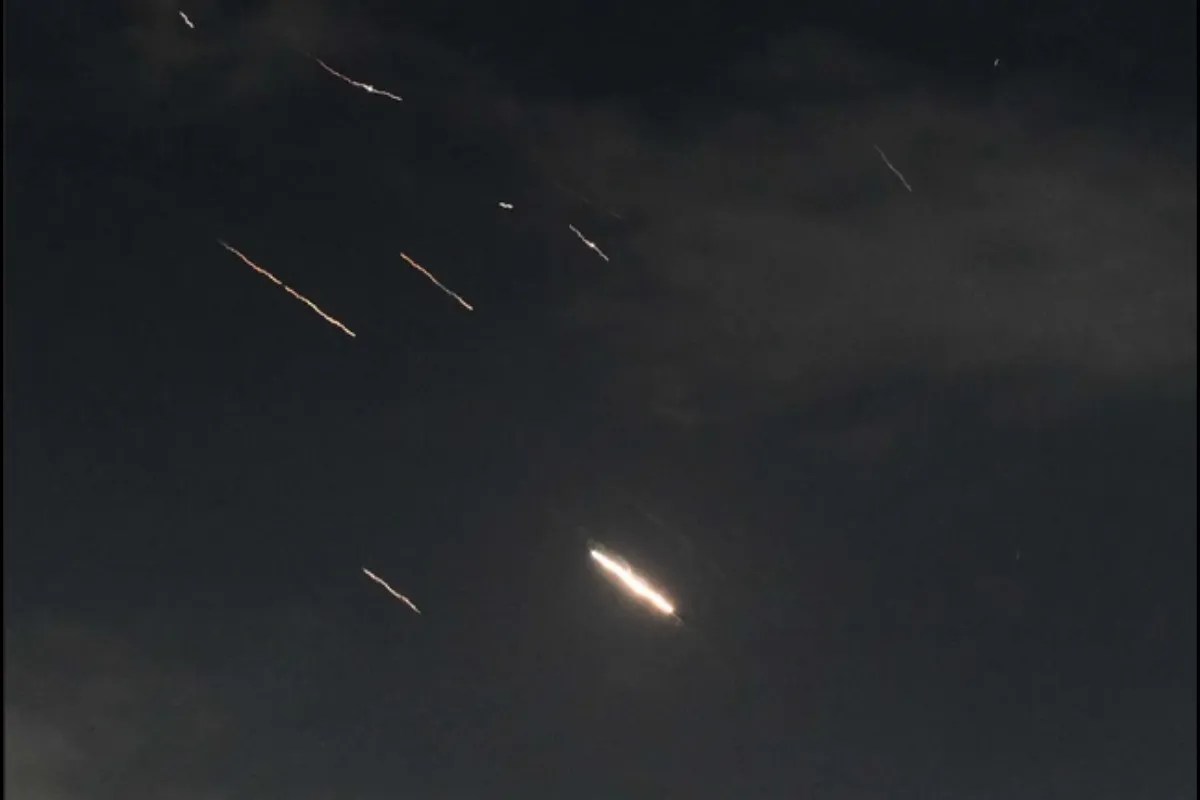
The recent offensive operations involving missile and drone strikes against United Arab Emirates (UAE) infrastructure represent more than a localized security breach; they serve as a stress test for the viability of the "integrated air defense" model in the Persian Gulf. This escalation cycle is governed by a distinct cost-asymmetry ratio where the offensive expenditure of low-cost loitering munitions forces a disproportionate defensive expenditure in interceptor missiles and economic disruption. Understanding this kinetic event requires moving beyond the surface-level reporting of "strikes" and instead analyzing the underlying logic of gray-zone warfare, the technical constraints of point defense, and the geopolitical calculus of forced instability.
The Architecture of Asymmetric Projection
The operational strategy employed in these strikes relies on three distinct technical pillars designed to overwhelm traditional radar and kinetic response systems.
- Saturation via Multi-Vector Sequencing: By launching a combination of slow-moving Unmanned Aerial Vehicles (UAVs) and high-velocity ballistic or cruise missiles, the aggressor forces the defender to manage two vastly different engagement envelopes simultaneously. The UAVs function as "clutter," soaking up sensor bandwidth and potentially depleting short-range air defense (SHORAD) magazines, while the missiles target hardened or high-value infrastructure.
- Low-Observable Flight Profiles: Loitering munitions often utilize low-altitude flight paths that exploit the "radar horizon" and terrestrial clutter. For a geography like the UAE, which features dense urban centers and coastal flatlands, detecting a small RCS (Radar Cross Section) target at low altitude remains a significant technical hurdle for ground-based systems like the Patriot or THAAD, which are optimized for high-altitude ballistic trajectories.
- The Interceptor Economic Gap: This is the primary driver of the conflict's sustainability. A single loitering munition may cost between $20,000 and $50,000 to produce. The interceptors used to neutralize them, such as the RIM-116 or the MIM-104 Patriot, cost between $1 million and $4 million per unit. This 1:100 cost ratio means the defender can technically win every kinetic engagement while strategically losing the economic war of attrition.
Strategic Objectives of Infrastructure Targeting
The selection of targets in the UAE is rarely arbitrary. It follows a specific logic of "Economic Deterrence," aimed at the UAE's unique position as a global hub for logistics, tourism, and finance.
Disruption of the Safe Haven Status
The UAE’s primary competitive advantage in the Middle East is its reputation as a stable, secure "Switzerland" of the region. Kinetic strikes, even those intercepted, generate "headline risk." This risk translates directly into increased insurance premiums for shipping (Hull War Risk), higher operational costs for airlines using Dubai or Abu Dhabi hubs, and a potential chilling effect on Foreign Direct Investment (FDI). The goal is to prove that no amount of geographic distance or defensive technology can fully insulate a globalized economy from regional instability.
Pressure on the Abraham Accords
The timing of such escalations often correlates with diplomatic shifts. By targeting the UAE, the aggressor signals to the broader region that alignment with Western or Israeli security architectures carries a tangible, physical cost. It is a tactical attempt to de-couple the UAE from its strategic partnerships by demonstrating that those partners cannot provide a 100% "iron dome" over sovereign Emirati territory.
The Technical Bottleneck of Air Defense
Current defensive doctrines are struggling to adapt to the "Drone Swarm" paradigm. The limitation is not just the quality of the interceptor, but the physics of the engagement.
- Sensor Saturation: Radar systems have a finite capacity for target tracking. When a "swarm" exceeds the track-and-compute limit of a fire-control radar, the system may prioritize incorrectly or fail to lock onto the most dangerous threat.
- Magazine Depth: An air defense battery has a limited number of ready-to-fire missiles. In a prolonged saturation attack, the defender faces "magazine exhaustion." Once the interceptors are spent, there is a reload window—often lasting minutes to hours—during which the site is defenseless.
- Geographic Density: Protecting a sprawling city like Abu Dhabi requires a high density of batteries. However, placing kinetic interceptors in urban environments creates a secondary risk: falling debris and "interceptor miss" consequences. The damage from a destroyed drone falling onto a residential block can often be as significant as the drone’s intended impact.
The Regional Power Calculus
The involvement of Iranian-backed proxies in these strikes provides Tehran with "plausible deniability," a core tenet of their regional strategy. This allows the central power to exert pressure and negotiate from a position of strength in international forums (such as nuclear talks) without triggering a direct state-on-state conventional war.
The UAE finds itself in a "security paradox." Increasing its military response risks further escalation and confirms the narrative of a conflict zone, which hurts the economy. Maintaining a purely defensive posture, however, allows the adversary to dictate the tempo and timing of every engagement.
Necessary Shifts in Defensive Doctrine
To counter this persistent threat, the current reliance on high-cost kinetic interceptors must transition toward a "Directed Energy" and "Electronic Warfare" (EW) centric model.
- High-Power Microwave (HPM) and Lasers: These systems offer a "near-zero" cost per shot. A laser system, once installed, only requires electricity to operate, effectively solving the 1:100 cost-asymmetry problem. HPM systems can neutralize entire swarms of drones simultaneously by frying their internal circuitry, bypassing the need for precise kinetic tracking of every individual unit.
- Localized Jamming Grids: Implementing "geofenced" electronic warfare zones around critical infrastructure—ports, refineries, and airports—can sever the command-and-control (C2) links of incoming drones or spoof their GPS coordinates, causing them to crash harmlessly in unpopulated areas.
The long-term stability of the UAE and the wider Gulf depends on the speed at which they can deploy these non-kinetic solutions. Until the cost of the defense is lower than the cost of the offense, the region will remain trapped in a cycle of asymmetric vulnerability where the aggressor holds the structural advantage. The move toward a localized, sovereign defense industry capable of producing these high-tech counters is no longer a luxury but a requirement for national survival in an era of persistent drone proliferation.
The strategic play for the UAE is not to match missile for missile, but to render the adversary’s low-cost arsenal obsolete through a technological leap into directed energy and autonomous, AI-driven sensor fusion. Failure to achieve this transition will result in a permanent state of economic and psychological siege.