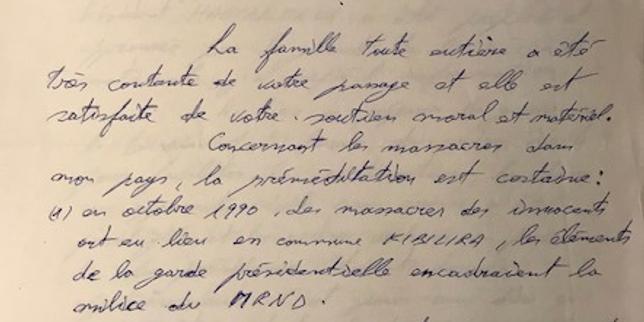
The emergence of unclassified intelligence reports concerning Agathe Habyarimana’s role in the lead-up to the 1994 genocide against the Tutsi reveals a sophisticated, informal governance structure that operated in parallel to Rwanda’s official state apparatus. While historical narratives often focus on the visible executive actions of President Juvénal Habyarimana, the declassified data points toward a "shadow executive" model. In this framework, political influence was not derived from a constitutional mandate but from the control of social networks, ethnic radicalization pipelines, and the strategic allocation of state resources through the Akazu—the "little house."
The Akazu as a Resource Extraction and Distribution Hub
The Akazu functioned as the primary engine for state capture. To understand its efficiency, one must analyze it through the lens of institutional density. By placing kin and regional loyalists from northern Rwanda (Gisenyi and Ruhengeri) into key positions within the military, the financial sector, and parastatals, Agathe Habyarimana facilitated a closed-loop system of patronage.
This system achieved three specific strategic objectives:
- Financial Autonomy: Control over the Banque Nationale du Rwanda and major agricultural exports (coffee and tea) ensured the inner circle had the liquidity required to fund militias without immediate parliamentary oversight.
- Military Infiltration: By influencing senior appointments in the Forces Armées Rwandaises (FAR), the Akazu ensured that the military’s primary loyalty shifted from the state to the regime’s radical core.
- Ideological Uniformity: The inner circle acted as a gatekeeper, filtering out moderate Hutu voices who favored the Arusha Accords, thereby narrowing the political options to a binary choice between total dominance or perceived annihilation.
The Mechanics of Influence Without Portfolio
Agathe Habyarimana held no official government title, yet her power was measurable through her role as a "veto player." In political science, a veto player is an individual whose agreement is required for a change in the status quo. Documentation suggests that ministerial appointments and diplomatic shifts were frequently vetted through her residence. This created a dual-track authority system.
The first track was the Formal Bureaucracy, which engaged in international negotiations and public diplomacy. The second track was the Informal Network, which Agathe Habyarimana anchored. This network utilized the Réseau Zéro, a clandestine group dedicated to the elimination of political opponents. The effectiveness of this dual-track system relied on plausible deniability; the President could project a moderate image to Western donors while the informal network prepared the logistics for mass violence.
Media as a Kinetic Weapon: The CDR and RTLM
The radicalization of the Hutu population was not a spontaneous social phenomenon but a calculated psychological operation. The inner circle’s involvement in the creation of the Coalition pour la Défense de la République (CDR) and the Radio Télévision Libre des Mille Collines (RTLM) transformed traditional media into a tool for demographic targeting.
- Dehumanization Metrics: Analysis of RTLM broadcasts shows a steady increase in the frequency of "Inyenzi" (cockroach) terminology, correlating directly with the distribution of weapons to the Interahamwe.
- Social Validation: By securing the public endorsement of the "first lady" figure, the radical Hutu Power ideology gained a veneer of traditionalist legitimacy. This signal told the rural population that the state’s highest echelons sanctioned the upcoming violence.
The logistical preparation for the genocide—the importation of hundreds of thousands of machetes and the creation of "hit lists"—required a level of administrative coordination that the formal civil service could not have executed without detection. The Akazu provided the necessary dark infrastructure.
The Breakdown of the Arusha Accords and the Zero-Sum Logic
The 1993 Arusha Accords represented an existential threat to the Akazu's economic and political monopoly. Integrating the RPF into the military and civil service would have disrupted the patronage networks that Agathe Habyarimana helped manage. Consequently, the informal power center shifted its strategy from political maneuvering to total systemic sabotage.
The strategy of "calculated chaos" involved:
- Assassinating moderate Hutu leaders to eliminate any viable third path.
- Creating a climate of insecurity through grenade attacks in Kigali, blamed on the RPF.
- The total polarization of the domestic political landscape, ensuring that any compromise was viewed as treason.
This zero-sum logic dictated that the survival of the Akazu was inextricably linked to the elimination of the Tutsi minority. The recently surfaced documents suggest that Agathe Habyarimana was not merely a passive witness but a primary architect of this "survival through elimination" doctrine.
Accountability Gaps and the Legal Complexity of Informal Power
The pursuit of justice for Agathe Habyarimana has been stalled by the inherent difficulty of proving criminal liability for an individual without an official chain of command. In international law, "command responsibility" usually applies to military or civilian superiors with formal authority. However, the Rwandan case challenges this by presenting a model of "de facto authority."
Evidence of her influence is often circumstantial or based on witness testimony regarding private meetings at the presidential palace. To bridge this gap, prosecutors must shift their focus from Direct Orders to Functional Control. This involves proving that:
- She exercised decisive influence over those who committed the crimes.
- She had the material ability to prevent the crimes or punish the perpetrators.
- She provided the ideological and logistical framework that made the crimes inevitable.
The refusal of France to extradite her, citing the principle of non-retroactivity in Rwandan law at the time of the events, highlights the tension between domestic legal protections and international human rights obligations. This creates a legal "gray zone" where high-level architects of mass violence can remain in a state of perpetual "administrative limbo"—neither tried nor fully exonerated.
Strategic Implications for Modern Atrocity Prevention
The Rwandan model of informal power serves as a critical case study for identifying early warning signs of mass atrocities in other volatile regions. Monitoring formal state institutions is insufficient; analysts must map the "social capital" of elite families and the flow of dark money within inner circles.
The following indicators are now considered high-risk variables:
- The rise of parallel security structures: When a regime begins arming civilian wings or tribal militias that report directly to an informal leader rather than the Ministry of Defense.
- Resource consolidation in the "Inner Circle": A measurable shift in the control of key economic sectors from the state to a specific kinship group.
- Ideological branding of the "First Family": When members of the executive's family are used to signal radical shifts in policy that the executive cannot officially endorse.
The current evidence regarding Agathe Habyarimana reinforces the necessity of a broader definition of "perpetrator" in international criminal law. If the global community focuses solely on those who pull the trigger or sign the execution orders, the true engineers of these systems—those who build the ideological scaffolding and ensure the machetes are purchased—will continue to evade accountability.
The strategic priority for international legal bodies is to develop more rigorous evidentiary standards for "influence-based liability." This requires a multidisciplinary approach combining financial forensics, social network analysis, and historical deconstruction of informal power structures. Without such a framework, the "shadow executive" remains a viable and low-risk blueprint for orchestrating state-sponsored violence. The Rwanda case is not an anomaly but a demonstration of how informal authority can weaponize a state against its own people while leaving the formal record blank.


