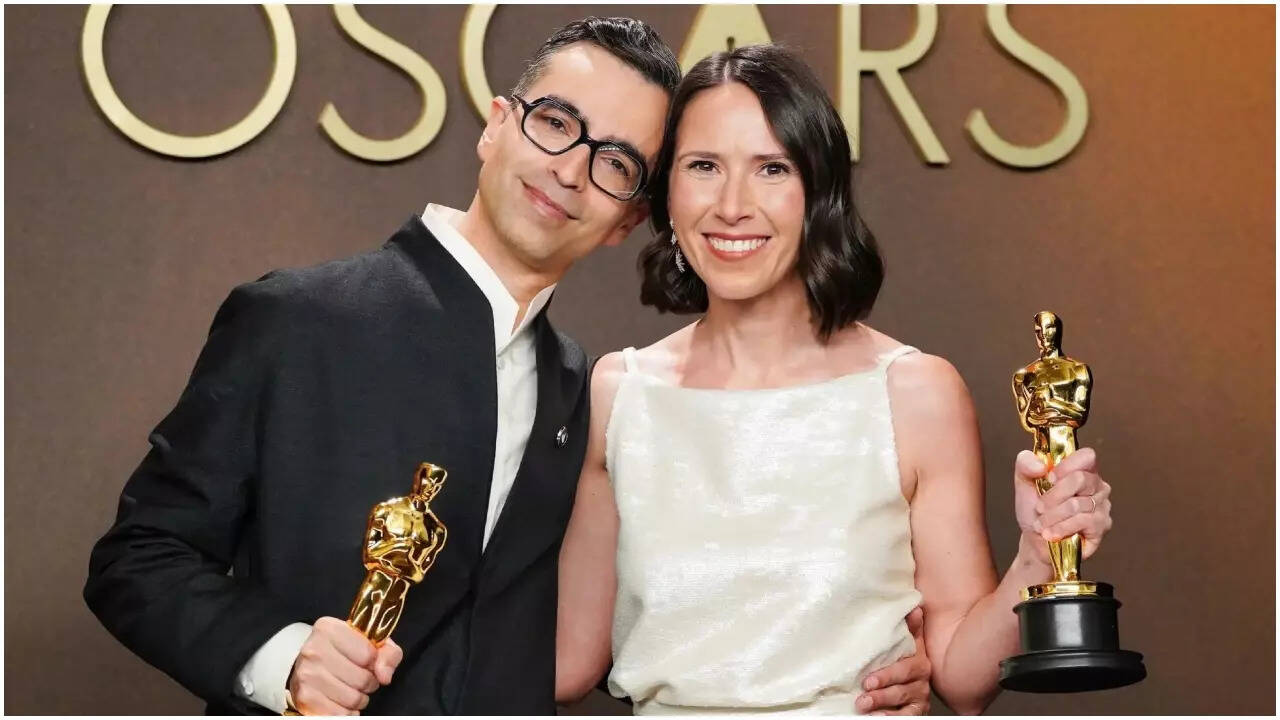
Alexandre Singh just did what many industry veterans spent decades failing to achieve. He took a surrealist, high-concept premise and turned it into an Oscar-winning reality. When the envelope opened for Best Live Action Short Film, the name called wasn't a safe, sentimental choice. It was a victory for "Two People Exchanging Saliva," a film that's as provocative as its title suggests. Singh, a filmmaker of Indian-origin who’s spent years blurring the lines between fine art and cinema, has officially crashed the Hollywood party. He didn't do it by playing by the rules. He did it by reinventing them.
Most short films try to be calling cards for feature deals. They’re often "lite" versions of something bigger. Singh’s work is different. It’s dense. It’s weird. It’s unapologetic. If you haven't seen the film yet, you’re missing a masterclass in how to use 36 minutes to dismantle social norms. This isn't just a win for Singh; it’s a signal that the Academy is finally growing an appetite for the avant-garde.
The Journey From Gallery Walls to the Dolby Theatre
Alexandre Singh isn't your typical film school prodigy. His background is rooted deep in the contemporary art world. For years, he was known for sprawling installations and performance pieces that felt like intellectual puzzles. You might remember his work from the Whitney Biennial or Palais de Tokyo. He’s always been obsessed with how humans communicate—or fail to.
Transitioning to cinema was a gamble. The art world and the film industry speak different languages. One prizes ambiguity; the other usually demands a clear narrative arc. Singh managed to bridge that gap. "Two People Exchanging Saliva" didn't come out of a vacuum. It’s the result of a singular vision that treats the camera lens like a canvas. He didn't just direct a movie. He choreographed a sensory experience.
Critics often get caught up in his heritage, labeling him an "Indian-origin filmmaker" as if that’s the most interesting thing about him. While his background informs his perspective, his aesthetic is global and fiercely individualistic. He grew up in France and the UK, and that European sensibility is draped all over his work. It’s dry. It’s intellectual. It doesn’t hold your hand.
Why Two People Exchanging Saliva Smacked the Competition
The title alone makes people uncomfortable. That’s the point. The film explores the biological and social implications of a kiss, but it’s not a romance. Far from it. It’s a surrealist comedy that dissects the act of intimacy until it becomes something alien and absurd.
While other nominees in the category focused on heavy political dramas or heart-wrenching family tragedies, Singh went for the jugular with wit. He used a heightened, almost theatrical style. The sets are meticulously designed. The dialogue is sharp. It feels like a fever dream that makes perfect sense while you’re in it.
The Academy usually plays it safe in the Short Film categories. They love stories about overcoming adversity or historical vignettes. By picking Singh, voters acknowledged that technical precision and artistic risk-taking matter more than "message" movies. The film's pacing is erratic in the best way possible. One moment you're watching a static, painterly shot, and the next, you're hit with a burst of frantic energy. It’s exhausting and exhilarating.
Breaking Down the Visual Language
Singh’s secret weapon is his collaborator, Natalie Djurberg. Their partnership brought a tactile, almost claymation-like feel to certain segments of the live-action world. They used physical effects where others would use digital ones. This gives the film a "crunchy" texture that feels real. You can almost smell the rooms the characters inhabit.
Most filmmakers are afraid of silence. Singh embraces it. He lets the camera linger on a character's face just a few seconds too long. It creates a tension that most shorts lack. He understands that in a short format, every frame is premium real estate. There’s zero fat on this film. Every costume choice and every prop serves a purpose in the larger allegory of human exchange.
The Impact on Indian Representation in Global Cinema
Let's be real about the "Indian-origin" tag. Usually, when a filmmaker of Indian descent wins big, the narrative is about "bringing Bollywood to the world" or "telling South Asian stories." Singh isn't doing that. He’s an Indian-origin man making weird, high-concept art that happens to be world-class.
This is a different kind of representation. It proves that creators from the diaspora don't have to be boxed into specific cultural themes to find success. They can be weird. They can be experimental. They can win the biggest prize in the world by being themselves rather than being "representatives."
Singh’s win follows a growing trend of Indian talent taking over the global stage, but he’s doing it from the fringe. He’s not making blockbusters. He’s making art. This win provides a blueprint for young filmmakers who feel like they don't fit the "indie darling" or "studio hack" molds. You can build your own mold.
Technical Mastery Over Budget
People think you need a massive budget to win an Oscar. You don't. You need a perspective. "Two People Exchanging Saliva" looks like it cost ten times what it actually did. That’s because Singh knows where to put the money. He prioritizes production design and sound.
The soundscape of the film is haunting. Every squelch, breath, and rustle is amplified. It forces you to focus on the physicality of the actors. It’s a reminder that film is a medium of the senses. If you’re a filmmaker starting out, study Singh’s use of sound. It’s the cheapest way to make your movie feel "big."
He also uses lighting to define space rather than just illuminate it. There are scenes in the film that look like Caravaggio paintings. He’s not afraid of shadows. In an era where most digital cinematography looks flat and "safe," Singh’s work is high-contrast and bold.
What This Means for Short Film Distribution
Short films used to die on the festival circuit. Now, with the Oscar win, Singh’s work is getting a second life on streaming platforms. This is the best time in history to be a short-form creator. The barriers are down.
If you want to follow in Singh's footsteps, stop trying to make a "mini-movie." A short shouldn't be a condensed feature. It should be an idea that can only exist in a short timeframe. Singh understood that the concept of "Two People Exchanging Saliva" would wear thin over two hours, but at 36 minutes, it’s a punch to the gut.
The strategy is simple: find an uncomfortable truth, wrap it in a beautiful aesthetic, and don't apologize for it. Singh didn't wait for permission to be weird. He just was.
The New Standard for Short Cinema
The win sets a high bar for 2026 and beyond. We’re seeing a shift away from the "earnest" short film. Audiences are savvy. They’ve seen the "sad piano music over a sunset" trope a thousand times. They want something that makes them tilt their head and say, "Wait, what did I just watch?"
Singh provides that in spades. He’s a reminder that the director is an author. His "voice" is audible in every frame. It’s a victory for the auteurs. It’s a victory for the art school kids who were told their ideas were too "out there" for Hollywood.
Go watch the film. Don't look for a moral. Don't look for a traditional ending. Just sit with the imagery. Observe how he handles the actors' bodies as if they were sculptures. Notice the way the dialogue loops and repeats, creating a rhythmic trance. This is what peak cinema looks like.
Next Steps for Aspiring Creators
If you’re inspired by Singh’s win, don't just go out and buy a camera. Start by looking at art. Read philosophy. Singh’s strength comes from his life outside of the theater. His influences aren't just other movies; they’re history, literature, and the absurdities of daily life.
Check out his previous work, like "The Humans," to see the evolution of his style. You’ll see a consistent thread of intellectual curiosity. He’s never satisfied with the first answer. He keeps digging until things get uncomfortable. That’s where the gold is.
The biggest mistake you can make is trying to be the "next" Alexandre Singh. The whole point of his career is that he’s the only one doing exactly what he does. Find your own "saliva." Find the thing that everyone else thinks is gross or boring or too complex, and make it beautiful.
Stop worrying about whether your story is "relatable." If it’s true to your vision, people will find a way to relate to it. Singh proved that a film about spit could win an Oscar. There are no more excuses.
Start by sketching your frames like a storyboard artist. Singh’s compositions are so precise because they are planned. Nothing is accidental. Every movement of the camera is a choice. Practice making those choices with intention. The era of "fixing it in post" is over for serious artists. The magic happens on the set, in the moment of creation.
The world doesn't need more "fine" movies. It needs more movies that demand to be seen. It needs more filmmakers who are willing to risk looking ridiculous to achieve something sublime. Alexandre Singh took that risk, and now he has a gold statue to prove it was worth it.