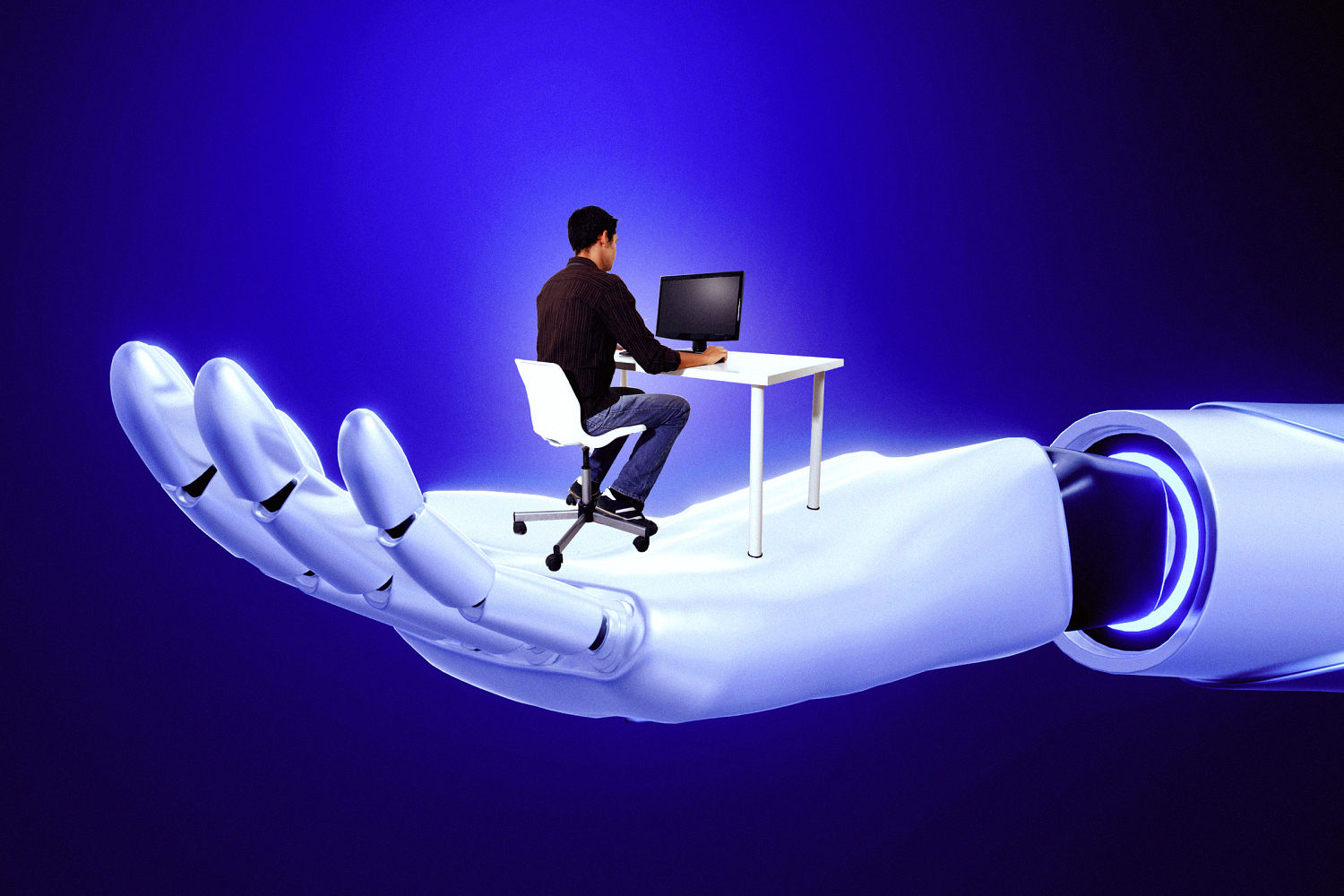
One in five American full-time workers just lost their tasks to a machine. That’s not a prediction for 2030 or some sci-fi fever dream. It’s happening right now. A recent survey from Beautiful.ai revealed that AI has already replaced work for 20% of the full-time workforce in the U.S. If you think your desk job is a fortress, you're looking at the wrong map.
The shift isn't just about robots on assembly lines anymore. It’s about the software on your laptop. While everyone was arguing about whether ChatGPT could write a decent poem, managers were quietly figuring out how to cut overhead. They found that automation doesn't just do things faster; it does them for pennies on the dollar.
The harsh reality of the 20 percent
Numbers don't lie, but they do tell a scary story. When 20% of workers say AI has taken over their responsibilities, we aren't talking about "augmentation." We’re talking about displacement. This isn't a minor tweak to the workflow. It's a fundamental rewrite of how companies operate.
The survey highlights a massive gap between what employees think and what bosses are actually doing. While many workers feel their "human touch" makes them irreplaceable, about 40% of managers in the same study admitted they'd be happy to replace employees with AI if the work stayed the same quality.
Managers aren't being mean. They’re being efficient. If a subscription to an AI tool costs $30 a month and replaces a junior analyst making $60,000 a year, the math is over before it starts. CFOs love that math. It turns out that a lot of what we called "specialized skills" were actually just repetitive digital tasks.
Why the middle class is the new front line
White-collar workers used to feel safe. We thought the "robot revolution" was for people who wore hard hats. We were wrong. AI is coming for the people who sit in climate-controlled offices.
Data entry is gone. Basic copywriting is on life support. Entry-level coding is being swallowed by LLMs. Even middle management is feeling the squeeze because AI can now handle scheduling, reporting, and basic performance tracking.
The survey found that 60% of managers are already using AI to increase their own productivity. But here's the kicker. They aren't always passing those time savings down to their teams. Instead, they're realizing they can run leaner departments. If one manager plus an AI can do the work of three managers, two people are getting a pink slip.
The productivity trap
Companies are obsessed with output. They want more, faster, and cheaper. AI delivers all three. But there’s a catch that nobody talks about. When you replace 20% of your staff with AI, you lose the "tribal knowledge" that keeps a company human.
The Beautiful.ai data suggests that while AI is great at the what, it struggles with the why. A machine can generate a 40-page deck on market trends in three minutes. It can't tell you why your biggest client is actually upset or how to navigate the ego of a difficult CEO.
Workers who survive this purge are the ones who stop acting like processors and start acting like strategists. If your job is to take data from Point A and put it into a report at Point B, you're a target. If your job is to look at Point B and decide it’s the wrong direction entirely, you've got a chance.
Managers are scared too
Don't think the C-suite is sleeping easy. The same survey showed that nearly half of managers worry that AI will eventually make their own roles redundant. It’s a race to the bottom.
Managers are currently using AI to stay afloat, but they're also training their replacements. Every time an executive uses an AI tool to summarize a meeting or draft a strategy, the underlying model gets smarter. It learns the patterns of leadership.
The tension in the American workplace is palpable. You can feel it in the Zoom calls. People are working harder to prove they're "essential," but how do you compete with a tool that doesn't sleep, doesn't need health insurance, and doesn't ask for a raise?
The skills that actually matter now
The era of the "specialist" might be ending. If you’re the "Excel guy" or the "PowerPoint girl," you’re in trouble. AI is better at those tools than you’ll ever be.
Instead, the market is shifting toward "AI Orchestration." This is the ability to manage multiple AI agents to produce a finished product. It’s not about doing the work; it’s about directing the work.
Soft skills are also seeing a massive price hike. Empathy, negotiation, and high-level problem solving are still human domains. For now. The survey suggests that the 80% of workers who haven't been replaced yet need to double down on the things a machine can't simulate.
What you should do right now
Stop ignoring the news. The 20% figure is a floor, not a ceiling. It’s going to go up.
First, audit your own week. Look at every task you do. If a task is predictable, it’s automatable. If it’s automatable, it’s gone. You need to identify which parts of your job require genuine human intuition and spend more time on those.
Second, start using the tools that are supposedly replacing you. If you aren't using AI daily, you're already behind. You want to be the person who knows how to use the machine, not the person who gets replaced by it.
Third, get comfortable with change. The old model of "learn a skill, use it for 40 years" is dead. You’re going to have to reinvent your role every six months. It’s exhausting, but it’s the only way to stay in the remaining 80%.
The displacement of 20% of the workforce isn't a glitch. It’s a feature of the new economy. Companies are leaning into this because it works for their bottom line. The question isn't whether AI will change your job. The question is whether you'll be the one holding the remote when it does.
Keep your skills sharp. Focus on the messy, human parts of your business. Machines hate mess. They love logic. Be the person who can handle the stuff that doesn't make sense. That's your only real job security.